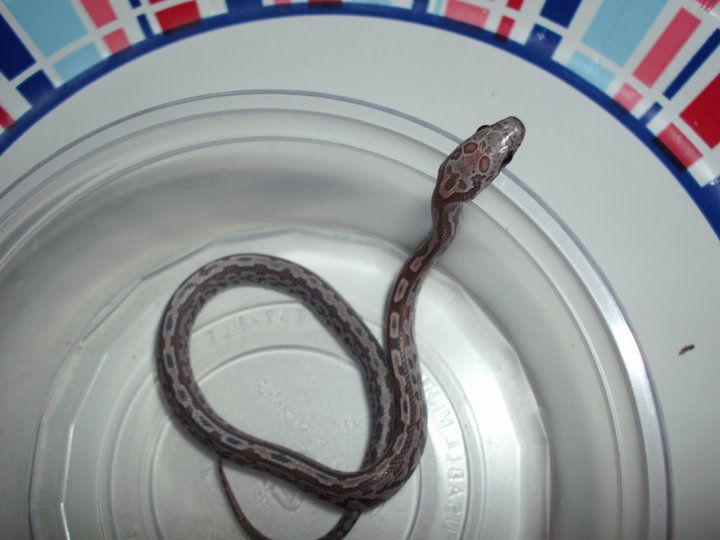
In an effort to protect the market integrity of new corn snake mutations and morphs, here at South Mountain Reptiles we employ prudent marketing and sales practices. Unlike the Ball Python and Hognose snake markets whose products sustain prolonged market vigor, corn snakes have always been over-produced and under-valued. Sometimes, in just two or three captive generations (and often after just one generation) new, rare, and exciting corn snake mutations and morphs crash to half their initial market value - or less.
Naturally, affordability is what all consumers desire, but for those who wish to purchase corn snakes as potential money-makers, premature market devaluation is all too common and disappointing.To date - just like most consumer products - ALL corn snake mutations and morphs have eventually reached affordable levels, so the initial high price of new corn morphs is no indication that they will never be affordable. Every new reptile morph that is offered to the public is initially offered at an INVESTMENT PRICE. Just like most products, the fewer there are for sale, the higher their prices. When supply of such products reaches or exceeds the level of consumer demand, prices begin to come down. Breeders expend great amounts of money, labor, and time in taking a new morph from discovery to market, and therefore deserve compensation for their investment, work, feeding, and maintenance expenditures.
What most people do not understand is that for every new morph that is popularly accepted by consumers, perhaps four such promising projects failed (in terms of expense compensation). This is sometimes because the economy wouldn't justify the price OR someone produced the same morph you did but offered them for less money OR the consumers and investors were simply not attracted to the new morph. This essentially means that for the hundreds or thousands of mice, dollars, and hours committed to five new and promising morphs, usually only one will reward the breeder with compensation for all five projects. In a market such as corn snakes - which is highly consumer-driven - profit on some morphs is frequently unattainable. Most corn snake sellers are fortunate if they have enough sales to pay their mouse bills, but since it is only a hobby for those who have other careers, and therefore do not rely on snake sales for their living, low or no profits are acceptable to them. For a few of us whose career is producing and selling corn snakes, without new projects to make up for the low-priced over-the-counter corns in depressed markets, reasonable profits can sometimes be difficult to attain. Therefore, new mutations and morphs like the Palmetto are essential for career snake-breeders so they can have the financial luxury of investing in other new mutations and morphs, without being forced out of business from insufficient sales.
My reason for detailing the pricing and marketing process is mainly because of the emails and calls I get over the years from frustrated snake lovers who wonder why a new morph like the Palmetto is so expensive and largely unaffordable. If you wait long enough, all new morphs will be affordable to the masses. It's not like the dog and cat industries that sell pet grade animals that have been altered so they cannot reproduce. They sell such altered animals as pets for much less money than the ones that are capable of reproduction.