• Hello!

    Either you have not registered on this site yet, or you are registered but have not logged in. In either case, you will not be able to use the full functionality of this site until you have registered, and then logged in after your registration has been approved.

    Registration is FREE, so please register so you can participate instead of remaining a lurker....

    Please be certain that the location field is correctly filled out when you register. All registrations that appear to be bogus will be rejected. Which means that if your location field does NOT match the actual location of your registration IP address, then your registration will be rejected.

    Sorry about the strictness of this requirement, but it is necessary to block spammers and scammers at the door as much as possible.

Snow Corn

Temano

New member
I was browsing the morphs section and decided to check up on different morphs and it got me to thinking about the albino at the shop i get my F pinks from.

They claim its an 'albino corn', knowing i bought mine as an albino corn(amel) i think thats compete bull.

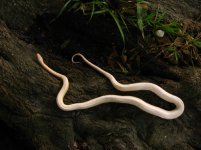
The snake is a white/light grey colour, i think its a snow-coral... But i'm only going from memory. I think they're selling it for about £90...

I'll be sure to post a pic later after i get Matilda's dinner.
 
In corns, there are more than one albino. You have an amel, which is often called a "red albino". Then there are anerys, which are sometimes called "black albinos". Combining amel and anery to get a snow which can also be called an albino.

Pet shops love using the term "albino" (which I personally don't like) and I'm really surprised they aren't calling butters "yellow albino", etc.
 
I am perfectly aware of the definition of albinism.

I was just curious about the terminology in reference to corns.
 
I wouldn't call it an ambigous term for pale morphs because Anery's aren't pale. They are black/brownish and grey. they just lack the reds. the Amels "albino" lack the blacks. when bred together you get the snows, or blizzards(depending on what type of Anery you have)
but as far as pet stores go, yes they call anything without black on it albino. well the ones out here do anyway.

It would help if you could snap a photo of it and post the pic here so the more knowledgeable people can tell you what it is and if that's a good price.
 
Oh right, so its an ambiguous term for a pale morph?

Basically. It is an ambiguous term for lacking pigmentation. Many animals (even humans) can exhibit albinism.

Sorry, I have to disagree. It's not ambiguous, and it doesn't even really refer to paleness. The confusion comes in because herps have more complex pigmentation than do mammals, for whom the term "albinism" has a narrower meaning. Knowledgeable people who are involved with herps thus often avoid the term "albino" due to the cross-over confusion it can cause. (Please don't assume that I meant that EVERYONE who uses this term is less than knowledgeable about herps. That's not what I meant.)

The term "snow" is a trade name for corns who are lacking in both melanin(amelanistic, or amel) and erthryn (anerythristic, or anery). Snow corns do not, therefore, have reds or blacks in their coloration. They can be quite colorful however, showing various degrees of peaches, pinks, yellows, and even a greenish tint. These colors are in addition to the white or ivory color commonly seen in adults. Baby snows are usually varying shades of pink. It takes a practiced eye to guess at a snow hatchling's eventual coloration - and it's a guess best offered if one knows the animal's parentage.

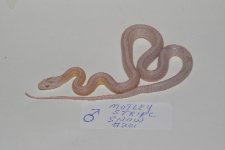
I'm attaching a picture of my snow motley/stripe Boz as a baby and as an adult.

I hope that was helpful.
 

Attachments

  • Boz baby resize.jpg
    Boz baby resize.jpg
    56.1 KB · Views: 75
  • Boz ACR rsz.JPG
    Boz ACR rsz.JPG
    128.5 KB · Views: 75
I went into the pet store where I got my opal corn looking for an amel. I saw an unlabeled corn that looked like an amel so I asked about it and they said no it's an albino. From what I understand from this post, if it had the red and orange pigment but was lacking the black pigment, then in this case amel and albino are the same. Is that correct? And if it is then why did they correct me and say it was an albino, not an amel?
 
I went into the pet store where I got my opal corn looking for an amel. I saw an unlabeled corn that looked like an amel so I asked about it and they said no it's an albino. From what I understand from this post, if it had the red and orange pigment but was lacking the black pigment, then in this case amel and albino are the same. Is that correct? And if it is then why did they correct me and say it was an albino, not an amel?


You're correct; a snake that has red and orange pigment but lacks black pigment IS amel. Many pet stores have excellent, well-informed workers. Many have workers who are well-informed in some areas, but not in all areas. My guess is that the worker who "corrected" your terminology only knows what s/he has read on the labels. Amels are often labelled "red albinos."
 
I went into the pet store where I got my opal corn looking for an amel. I saw an unlabeled corn that looked like an amel so I asked about it and they said no it's an albino. From what I understand from this post, if it had the red and orange pigment but was lacking the black pigment, then in this case amel and albino are the same. Is that correct? And if it is then why did they correct me and say it was an albino, not an amel?

Because you went to a pet store. Most people in pet stores are not knowledgeable about anything they sell, much less what types of morphs they have. The only reason I say this, is because years ago I was one of those poor saps.
 
Thanks Caryl, I will keep this in mind if I am looking in the future. This pet store takes really good care of their reptiles and is mostly very knowledgeable about care. I think it must be one of those cases where they are well-informed in some areas but not in others. They also have a reptile manager that works twice a week that probably could have given me more accurate information.
 
Thanks Caryl, I will keep this in mind if I am looking in the future. This pet store takes really good care of their reptiles and is mostly very knowledgeable about care. I think it must be one of those cases where they are well-informed in some areas but not in others. They also have a reptile manager that works twice a week that probably could have given me more accurate information.

Our local "snake expert" is great with the care of the animals. She does very well and breeds her corns often, but she makes up her own names for morphs that she breeds. And simply refuses to come to this website...lol
 
Thanks Caryl, I will keep this in mind if I am looking in the future. This pet store takes really good care of their reptiles and is mostly very knowledgeable about care. I think it must be one of those cases where they are well-informed in some areas but not in others. They also have a reptile manager that works twice a week that probably could have given me more accurate information.

You're welcome. ;)

Our local "snake expert" is great with the care of the animals. She does very well and breeds her corns often, but she makes up her own names for morphs that she breeds. And simply refuses to come to this website...lol

Oh boy, do I know somebody like that!! :headbang:
 
Caryl, my intent was the same as yours- i guess I just was not clear enough on that. I only used the term ambiguous as an imitation or copy of the prior post. Although, to the outside world I guess it is USED as an ambiguous term- meaning ALL pigmentation, not just melanin. It is a loosly used term. Here is a definition:

Albinism (from Latin albus, "white"; see extended etymology, also called achromia, achromasia, or achromatosis) is a congenital disorder characterized by the complete or partial absence of pigment in the skin, hair and eyes due to absence or defect of an enzyme involved in the production of melanin.

Any, I guess you could say, 'noticeable' loss in melanin would be considered albinism. There are plenty of mammals that are just as complex if not more so then snakes (corns in particular) but the difference is, we have just been able to isolate A LOT more of the genetic locus in corns. I have bred horses for many years following the same procedures, it is a lot harder to narrow down different color morphs and patterns then it is in corns. In horses, you can get what is called a 'lethal white' (which die) which, in the horse world is also referred to as an 'albino' even though there are real albino living horses out there.
 
I was simply curious about the different terminology used, there is obviously lots of variation in morphs and in peoples opinions of what a morph constitutes as.
 
Caryl, my intent was the same as yours- i guess I just was not clear enough on that. I only used the term ambiguous as an imitation or copy of the prior post. Although, to the outside world I guess it is USED as an ambiguous term- meaning ALL pigmentation, not just melanin. It is a loosly used term. Here is a definition:

Albinism (from Latin albus, "white"; see extended etymology, also called achromia, achromasia, or achromatosis) is a congenital disorder characterized by the complete or partial absence of pigment in the skin, hair and eyes due to absence or defect of an enzyme involved in the production of melanin.

Any, I guess you could say, 'noticeable' loss in melanin would be considered albinism. There are plenty of mammals that are just as complex if not more so then snakes (corns in particular) but the difference is, we have just been able to isolate A LOT more of the genetic locus in corns. I have bred horses for many years following the same procedures, it is a lot harder to narrow down different color morphs and patterns then it is in corns. In horses, you can get what is called a 'lethal white' (which die) which, in the horse world is also referred to as an 'albino' even though there are real albino living horses out there.

You're quite correct in the etymology of albinism. Unfortunately, most people don't research the etymology of their terminology! :poke: It's the usage of the term albino that causes confusion. Most people think of "albino" as white, since that's its original derivation.

Yes, mammals have many complex genetic pigmentation patterns. I didn't mean to imply that that do not. The pigmentation in herps is very different, though. IMHO, our understanding of corn snake colors, patterns, and loci is due in part to the fact that until Dr. Bechtel caught and bred that first wild amel, corns were all wild type. (I mean that in the genetic sense.) Yes, many individuals have worked intensely since that time, keeping careful records and poring over these records for countless hours. This time and effort is much appreciated by those of us who benefit from their efforts.

Mammals - including those beloved horses - have been selectively bred for millenia. Our understanding of their colors and patterns is different as a result of this history, as well as of their differences in inheritance pattern.

I'm all too well aware of "lethal whites." They occur in many mammals, not just horses.

Don't you wish we could all understand each other's intention, not just the words? I hope this post makes sense. I've got a horrid headache.
 
Thanks Caryl, that was a great post. It has given me a lot to think about and research. I actually LOVE studying things like this as I find it very fascinating. Since the last post I have been doing some reading and never realized that mammals had such significant amounts of melanin when compared to a reptile, where i can see the meaning of 'genetically less complex' and why it is associated with 'completely white'. I will keep reading on this as it has piqued my curiosity.
 
That's a nice compliment, Tara. Genetics is definitely an area of fascination for me, too.

(By the way, I see you're a 4H leader. :cheers: That's cool!)
 
I went into the pet store where I got my opal corn looking for an amel. I saw an unlabeled corn that looked like an amel so I asked about it and they said no it's an albino. From what I understand from this post, if it had the red and orange pigment but was lacking the black pigment, then in this case amel and albino are the same. Is that correct? And if it is then why did they correct me and say it was an albino, not an amel?


Probably because they come from the supplier labeled as albino and she wasn't aware that amel and albino (or red albino) is the same as amel.
 
(By the way, I see you're a 4H leader. :cheers: That's cool!)

Thanks! Yes, we just started the 4H recently. My son wanted to get into a reptile 4H and we looked around and found that there was not a reptile 4H in this area at all! So, we decided to start our own. Right now we partner with my mom's poultry 4H but we've already had so many kids interested that we are going to form our own group next month. I don't know how I am going to handle it all if too many kids join but I would never want to turn any kids down, I hope I don't get over my head too quickly. I will probably be coming to you guys for LOTS of advice as it picks up. Also hope to have a web-site up and running soon.
 
Back
Top