• Hello!

    Either you have not registered on this site yet, or you are registered but have not logged in. In either case, you will not be able to use the full functionality of this site until you have registered, and then logged in after your registration has been approved.

    Registration is FREE, so please register so you can participate instead of remaining a lurker....

    Please be certain that the location field is correctly filled out when you register. All registrations that appear to be bogus will be rejected. Which means that if your location field does NOT match the actual location of your registration IP address, then your registration will be rejected.

    Sorry about the strictness of this requirement, but it is necessary to block spammers and scammers at the door as much as possible.

The Hypererythrism Thread...

chris68

Arundel Reptiles
hyper-
prefix
1. above, over, or in excess hypercritical
2. (in medicine) denoting an abnormal excess hyperacidity
3. indicating that a chemical compound contains a greater than usual amount of an element hyperoxide
[from Greek huper over]

er·y·thrism (r-thrzm)
n.
Unusual red pigmentation, as of hair or plumage.

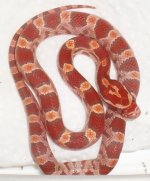
A greater than usual amount of red pigmentation...I'd say that sounds like "redcoat" or "Neon" or all the other "red factors" everyone has been pulling their hair over ;). I'd like to start this thread so everyone can start getting their heads together, post results, ideas, theories etc. so we can begin to completely unwrap the mystery behind them. For years we've all seen the various awesome looking Salmon Snows, the Champagnes, we've started threads trying to pin down "that look". Lets get it figured out :*).

I'll start with just a suggestion. The different names i.e. "red mask", "neon", "coral" are neat, but confusing. Maybe we need to start identifying each individual "factors" we know or find to be it's own by a common identifier; Hypererythrism Type A, then B, C....
 
This should be an interesting thread to read. I am only in my second year of working with the red gene here. I do have my speculations about what I have here and am anxious for last years kids to be old enough to breed.
So far what I see is when combined with amel or ultra the gene shows itself more readily in F1. I did do three breedings with my male this year to females that did not show the gene.
First breeding was red factor ultramel het diffused, anery to anery stripe het hypo, caramel ph amel. The female proved not to be ph amel. The clutch was a mix of normal and anery babies. A couple of the normals did show more color than the rest of the clutch and the aneries did not differ from one another. There are aneries from last years breeding around and am not seeing much color to them at all.
Second breeding was red factor ultramel het diffused, anery X normal het diffused, sk, amel. Most of the red babies were ultramels, one fire and a couple amels. All showing different degrees of red. But when compared to other hatchlings not from a rf breeding there is a significant difference in the amount of red my hatchlings have compared to thiers. The normals were very nice with a couple being very bright as compared to thier siblings.
The third breeding has not hatched as of yet. Rf to pure hunt club okeet. The female carrying no known hets should be interesting and I plan on holding a pair back from it to breed for f2 to see if color increases or not.
The male I am using is from the "Cherry" line of RF. And the genetics were used in the making of neons. To me just looking at him compared to other red gene animals on here and other places there is a difference in appearance the redcoat seems to be a darker red as in the difference between candy apple red and blood red in paint.
Some where I read that the "red" genes do not play well together when combined I would like to test that further.
I have picked up another male that looks to be of some red gene influence but testing will determine it later on. To me it seems that there are too few working with it and most are working with what seems to be a different form of it and hopefully this thread will narrow some things down for us all.
 

Attachments

  • ultramel2.jpg
    ultramel2.jpg
    96.9 KB · Views: 97
Oh I can't wait for this thread!! I haven't been actively been working with red factor but I knew that there was something more to my boy Auger (He is my avatar) despite many telling me he was a normal. It was brought to my attention that he might be a red factor. Well this kind of explained some of my breeding's with him.

First year I bred him I ended up with mostly snows just a few anery's and one amel but there was just something wrong with a few of the babies. Some of the snows were much pinker than the others and a few of the normals were RED. It was obvious that these were still normal and not hypo's but I was confused as to what was going on. So the second year I bred him to the same girl again. This year I had some anery's that looked different from each other, some smoken red amels like this girl that her owner does a great job keeping us updated http://www.cornsnakes.com/forums/showthread.php?t=115607&highlight=wilma and again some red normals and pink snows.

Here are some example of my different looking anery's. They have very pinky undertones. Well I know that the 2010 female still does unfortunately I let the 2011 go so I don't know how he is progressing.

2011 male
picture.php


2010 Female
016.JPG

It should be interesting to see how my boy sizes up with what everyone else is seeing in their known red factors. Like Bob obviously I am seeing evidence of this red gene in F1 but unlike Bob I do see a difference in my anery's some are very typical black and gray and some are very light pinky looking.
 
This will definitely be interesting, but I predict it will still be confusing. My main concern is where the cut-off will be in determining is a corn snake has extra red or not. In some cases, yes, it will be quite obvious, but others will not be that easy. Then you'll run into: "Is it selective breeding, het influence, more than one gene, just natural variation within a clutch, or a combination of 2 or more of these?" Personally, I don't think we'll be getting any answers any time soon, but gathering as much data as possible now will surely help find the answer(s) in the future.
 
This will definitely be interesting, but I predict it will still be confusing. My main concern is where the cut-off will be in determining is a corn snake has extra red or not. In some cases, yes, it will be quite obvious, but others will not be that easy. Then you'll run into: "Is it selective breeding, het influence, more than one gene, just natural variation within a clutch, or a combination of 2 or more of these?" Personally, I don't think we'll be getting any answers any time soon, but gathering as much data as possible now will surely help find the answer(s) in the future.


I do agree with you Susan. I have seen snakes that were said to be red gene but didn't look it. For my own clutches I compare them to examples of the morph without the gene present.
As young as my project is, I still have a few years to go before I can say one way or another. For now speculation is most of what we have.
 
Back
Top