
-
Hello!
Either you have not registered on this site yet, or you are registered but have not logged in. In either case, you will not be able to use the full functionality of this site until you have registered, and then logged in after your registration has been approved.
Registration is FREE, so please register so you can participate instead of remaining a lurker....
Please be certain that the location field is correctly filled out when you register. All registrations that appear to be bogus will be rejected. Which means that if your location field does NOT match the actual location of your registration IP address, then your registration will be rejected.
Sorry about the strictness of this requirement, but it is necessary to block spammers and scammers at the door as much as possible.
You are using an out of date browser. It may not display this or other websites correctly.
You should upgrade or use an alternative browser.
You should upgrade or use an alternative browser.
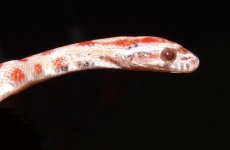
What's wrong with this baby?
- Thread starter Jadie.Glitch
- Start date

Chip
ΜΟΛΩΝ ΛΑΒ&
The dark splotches don't appear to show up on the "white" part of the animal, facial scales, and where they "might" be they are reddish. Notice the clean line behind the eye and the two belly checkers. I've never had a paradox, but I believe you do.
Jadie.Glitch
:) colubridstudios.com :)
It would be amazing if I happened to get another one when I pair the parents together again... and opposite gender from the one I have would be nice too  . I understand that this may be just a genetic defect but I want to try to prove it out anyways. If this turns out to be a het it would be fantastic!
. I understand that this may be just a genetic defect but I want to try to prove it out anyways. If this turns out to be a het it would be fantastic!
Silvergrin
New member
Cool! A paradox albino corn! What were the parents? Were they both albino?
I believe there have been a few "calico" corns before and none were proved genetic, but I've never heard of a paradox albino corn. I hope it is heritable! I think your best bet is to breed him/her back to a parent, and then breed offspring to him/her and sib/sib.
Yeah it's a bit of inbreeding but it's the quickest way to see if it's a heritable trait. Might even be a new mutation!
I believe there have been a few "calico" corns before and none were proved genetic, but I've never heard of a paradox albino corn. I hope it is heritable! I think your best bet is to breed him/her back to a parent, and then breed offspring to him/her and sib/sib.
Yeah it's a bit of inbreeding but it's the quickest way to see if it's a heritable trait. Might even be a new mutation!
Jadie.Glitch
:) colubridstudios.com :)
Dad is an okeetee and mom is a normal... (technically they're both normals, but you know..).
I am a little leary of the whole "inbreeding" thing though... I know it causes BAD things in mammals... why is it so widely accepted in reptiles??
I am a little leary of the whole "inbreeding" thing though... I know it causes BAD things in mammals... why is it so widely accepted in reptiles??
Jadie.Glitch
:) colubridstudios.com :)
Sorry, forgot to mention that it would be a great idea if I want to quickly prove if it's inheritable or not ^_^. Didn't mean to make it sound as if I was questioning your methods, 'cause I'll still most likely try later anyways even though I have some reservations about it .
.
Chip
ΜΟΛΩΝ ΛΑΒ&
Dad is an okeetee and mom is a normal... (technically they're both normals, but you know..).
I am a little leary of the whole "inbreeding" thing though... I know it causes BAD things in mammals... why is it so widely accepted in reptiles??
Because it doesn't present problems in the same way. The genetic material shared is so much more complicated in a mammal than a reptile. An outcross here and there will clear any kinking or weirdness in most herp cases if a problem ever IS occurred. Herps don't typically travel long distances and inbreed in the wild regularly far more than mammals is my guess as to why this is.

Silvergrin
New member
No prob, it's good to question!
Inbreeding really isn't that bad, even in mammals. It depends what traits are hidden; most loss-of-function mutations are recessive, because the functioning gene can make up for the non-functioning one. So, if an animal has some hidden detrimental hets (instead of the ones we want to see!) inbreeding can bring those out.
However, keep in mind that even if two animals were 100% identical (and sibs are only 50% identical), there'd only be a 1/4 chance of a given "bad" mutant expressing. The probability of seeing something bad increases with however many bad genes there are.
Anyway, there are, for example, strains of mice and cows that are highly inbred, to the point where more inbreeding is fine because all the bad mutations have been eliminated (although spontaneous new ones can occur)
When it comes to snakes, or any critter, you'd probably need several generations of inbreeding before you noticed any loss of vigor, unless the snake was hiding some kind of spectacularly bad mutation.
Anyway, genetics lecture aside, since the parents are not both albinos (in fact, neither is) I suppose it's possible that your animal is some kind of mosaic? Like, made up of two different cell lines.
But back to inbreeding; would be especially useful if the paradox albino was due to several genes working together. Anyway, it's a good idea to avoid inbreeding when you can, but it's not super-bad either, and useful when you're trying to establish a gene.
Inbreeding really isn't that bad, even in mammals. It depends what traits are hidden; most loss-of-function mutations are recessive, because the functioning gene can make up for the non-functioning one. So, if an animal has some hidden detrimental hets (instead of the ones we want to see!) inbreeding can bring those out.
However, keep in mind that even if two animals were 100% identical (and sibs are only 50% identical), there'd only be a 1/4 chance of a given "bad" mutant expressing. The probability of seeing something bad increases with however many bad genes there are.
Anyway, there are, for example, strains of mice and cows that are highly inbred, to the point where more inbreeding is fine because all the bad mutations have been eliminated (although spontaneous new ones can occur)
When it comes to snakes, or any critter, you'd probably need several generations of inbreeding before you noticed any loss of vigor, unless the snake was hiding some kind of spectacularly bad mutation.
Anyway, genetics lecture aside, since the parents are not both albinos (in fact, neither is) I suppose it's possible that your animal is some kind of mosaic? Like, made up of two different cell lines.
But back to inbreeding; would be especially useful if the paradox albino was due to several genes working together. Anyway, it's a good idea to avoid inbreeding when you can, but it's not super-bad either, and useful when you're trying to establish a gene.
Jadie.Glitch
:) colubridstudios.com :)
Awesome, thanks for the info! That clears things up for me ^_^. Can't wait til the little bugger grows up! I'm a curious one >_<... I understand that nothing substantial may come from trying to find out if this is a trait or not... but I've grown rather attached to the little guy and any angle I can use to keep him (my fiance said sell!) works for me!
cornsnakeboy12
New member
parodax sorry I a noob what is that?
Silvergrin
New member
I heard about it from kenyan sand boas. Paradox albino means that the animal is mostly albino, but has random patches of normal (non albino) pigment. In KSB at least the trait is genetic.

DeprivedSnakeLover
Lover Of The Bloods!
name it pepper!

RavenSpirit360
Mitakuye Oyasin
Updated pics would be nice!!!

sinisterserpents1
Love All, Trust A Few
Updated pics would be nice!!!
oh oh oh I agree lol:dancer:


Snakewhisperer
Reptiholic
These freckled paradox dudes are becoming more and more common I think, hope thats what he/she is