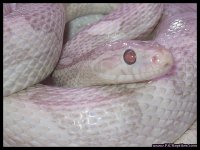
Thanks Matthew, Jay and Tim for your comments.
Jay, that's a very nice specimen, he sure give's a reason for the name Lavender.
Tim, I really didn't want to sound like you
needed to prove it. I only asked because back then you mentioned "not proven yet". Sorry if it sounded otherwise.
I’ve been working with a group of animals for a while now which at the very first I thought were special lavenders. Some observations and discussions with other breeders brought to the possibility that they are something different than lavender. Since then they have been referred to as mystery hypos, true ghosts, milky hypos, and even dilutes. Personally, as long as they’re not proven to not be lavenders, I’m a bit reluctant to coin them a trade name (even if I like the “true ghost” name). Some of the reasons for suspecting they were maybe something else are the fact that the pinks and peach tones were more pronounced, they had a milky/glossy look to them, AND when combined with Anery A the phenotype silver, no traces of the faintest pink, but hints of very diluted yellow in the neck area. In subsequent generations, the faint yellow in the neck area became not so faint, but all other characteristics remained. The effect of combining this mystery strain with Anery A has been consistent (but for the anterior yellow) at all breeding trials. I also had an Anery Lavender (proven) and her color was more like Tim’s first pic. I figured that if Anery Lavs looked exactly like Mystery Lavs, it would be case closed: mystery = Lav, period. I’ve also seen one picture of an Anery Lav that looks just like my Mystery Lav Aneries.
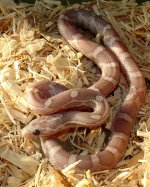
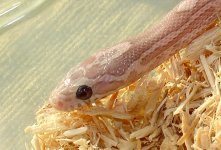
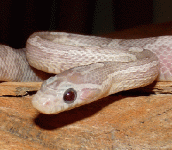
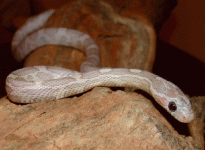
Anyway, here’s a sample of those Lavs. Let me know what you think.
This is an Anery A “Mystery Lav” F2
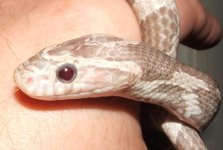
This is the original male "Mystery Lav" (not the father of above)
A young “Mystery Lav” F2




.jpg)