mice size descriptions;
Pinkies
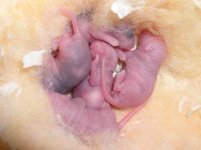
Herpetological feeder mice are born completely hairless, sightless, and entirely dependent on maternal care for survival. Because they have no hair, the pink-colored skin from which they draw their common name is their most conspicuous feature. During the first week to ten days of life, pinkies triple their birth weight from approximately 1 to 3 g. and gradually begin to grow body hair. Precocious individuals may also start to open their eyes during the latter part of this period.
Fuzzies
Fuzzies, or mouse pups, are 3 to 6 g. juveniles who are still dependent on maternal care. Their eyes are just opening, a process which takes place over several days, but the ears are still small and non-erect. The primary feature of a fuzzy mouse is the ample growth of hair which starts at the shoulders and back and gradually covers the entire body, affecting the legs, ears, and muzzle last. Fuzzy mice represent the middle 7-10 day period of the 3-4 week growth process from newborn pinky to herpetological feeder mouse.
Feeders
Feeders are also called hoppers, jumpers, weaners, and a variety of other local names. They are 8 to 15 g. sub-adults with fully formed erect ears, completely opened and functioning eyes, and have been weaned onto solid food. They have good muscular coordination. Depending on litter size, genetic strain, peer competition, and the quality of the dam's milk, the feeder stage is reached within about 3-4 weeks of age, at which time they are completely self-sufficient and able to fend for themselves.
Captive maintenance and selective breeding
by mouse fanciers has been carried on for hundreds of years, but scientific interest in the Common Mouse begun by Nineteenth Century researchers has led to many strains of Mus musculus. It is from these domesticated populations that herpetologists first obtained excess animals as feeder mice for their carnivorous reptiles and amphibians.
(The house mouse) In addition to great habitat tolerance, they are also characterized by a rapid reproductive cycle which can result in one million descendants after only 425 days (Harkness and Wagner - 1983.)
In nature, population explosions take place which can reach plague proportions; during a 1926-27 California episode an estimated population of 82,000 mice per acre decimated areas of the Great Central Valley.
During these periods of over-population, however, young females tend to become infertile (Whitaker - 1980),
which exerts an inhibiting effect on further population growth.
http://www.xmission.com/~gastown/mousehouse/
The tendency for females to become infertile when over-populated in the wild may possibly apply to crowded captive mice breeding conditions.
Yields per mouse may possibly increase in less crowded conditions.
Has anyone noticed this to be the case in ones breeding colonies, i.e. the same strain of mice (siblings) producing more pinks per momma in say a less crowded 1.2 group setup compared to say a... 1.5 group?
I can see it now, uncrowded, wide open spaces, "free ranging mice" justa "chillin' out... home home on the range, where the deer and the micees play... up to there necks in pinkys...barefoot and pregnant, thats how we like em.