• Hello!

    Either you have not registered on this site yet, or you are registered but have not logged in. In either case, you will not be able to use the full functionality of this site until you have registered, and then logged in after your registration has been approved.

    Registration is FREE, so please register so you can participate instead of remaining a lurker....

    Please be certain that the location field is correctly filled out when you register. All registrations that appear to be bogus will be rejected. Which means that if your location field does NOT match the actual location of your registration IP address, then your registration will be rejected.

    Sorry about the strictness of this requirement, but it is necessary to block spammers and scammers at the door as much as possible.

Breeding Mice/Rats

I have found that helps too Susan. Although I hardly ever take the time to do this. Normally just whack the old and set up the new *L* But the mothers are definitly better for it when I do keep an older one in with young ones.

Also another thing I have found...not related....

I find I have the best luck, and the breeding starts faster if I use a slightly larger male, or even better a "re-run" male. The females wear out fast, like 10 months-1 year or even far less, but the males can continue breeding (depending on your ratio obviously, I have a fairly small colonys with 1.3 or 1.4) I usually set up a male with a new "batch" of females twice, and have had some even go three times. These older larger males are quick to establish "respect" with a new group of females, and quick to start mating.

bmm
 
Parenting Classes for Mice...great concept...

The older teaching the younger generation of rodents parenting skills is a wonderful idea.

Great concept, using your best mommas as teachers, I'm going to run with that idea.
The practice of Re-Running Males, sounds very feasible too.

The retaining of replacement breeder males from the same colony through several generations without any problems... being fathers are pretty tolerant of a young male...
makes for a great tid-bit of information too.

Is this applicable to rats?

Thanks for the brain food everyone, informative thread here

:D
 
Last edited:
I've not had many problems with my rats, but have set up the same practices with them as I have done with the mice. I do know that the rats share responsibility of raising pups. I can be very difficult to determine who is the real mom in the colony at times. Some younger females can be very possessive with pups. I've watched a female continually move a poor pup all over the tank to keep another one from taking it, and when the other female gets it, the process starts all over again. (This happens mostly when there is only a few pups left after I've taken most for snake food or the others got "mooshed" from all the adults sleeping on them.) I have been able to transplant pups from one tank to another with fairly good results (tank A just had three large litters at the same time but tank B just had a small litter...so some pups from tank A get fostered in tank B). You can't do this with mice in my experience. I've also had little problem with introducing a new male or female of breeding age to an established rat colony. Whether this is a normal occurance with rats or because all my rat colonies originated from a single group and are therefore all related anyway, I can't tell. And all my rats are definately pet tame, even though they are rarely handled. I've never been bitten by a rat. And my mice only give me a good bite once...immediate "whacking" is the punishment for biting and drawing blood at my house. They never do it again that way.
 
Question?

How long of a brake should u give the female after her pups are gone which would prbaly be small hopper size??? is that a long enough brake away from the male or does she need some free time
 
I assume you are talking about mice. In my case, I have tried removing the females before they give birth and keeping them separate. This is the method that seems to be preferred by the people who raise pet mice. My experience is that there is so much stress and fighting when you reintroduce the male that it is better to just leave the male with the females all the time. In this case, the female get's reimpregnated within a week of giving birth. (I'm sure the thought of this make's all of you mothers in the audience shudder!!!) I think this is what the majority of the people who breed mice for food do.

Mark
 
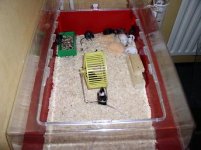
i have them in a almost too large cage...

i have my mise in a cage were a guinie pig would fit in(there was one in untill it died)i put all my mise in the big cage, but when one is pregnant, or is under attack by the other mise,
--?!?i didnt found out why?!?--
i put them aside in a other cage, pregnants always with each other because other moms care for the other moms babies!!!
i always give the mise toys and all the things they need,
often give them some extra vitamins.
i really ive them my attetion,
and make them happy and here is the result;
EVERY WEEK A NEST OF YOUNG MISE
maybe it is just luck,but ive had this for a long time so i would be very lucky!!!
on the pic, i removed the houses so the mise also has a hidout
 

Attachments

  • hele bak.jpg
    hele bak.jpg
    18.1 KB · Views: 92
other pic

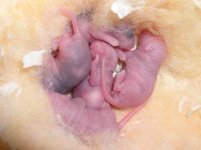
here are some babies...arent they cute????when i started breeding mise, and feeding them to my snakes, i had some problems with it, but you get used to it.
 

Attachments

  • kleiner.jpg
    kleiner.jpg
    12.5 KB · Views: 91
other shot

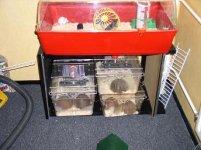
here you see all my cages, under the cages for the pregnant and ''injured''
above, you see the big cage, i wonder if someone has a bigger one??????????
 

Attachments

  • alle bakken.jpg
    alle bakken.jpg
    21.7 KB · Views: 92
forgot to add i have 6 tubs,of 1.6 and 1.4
you guy's with the freedom racks,
so any big breeders out there, ???
any help
cheers guy's
 
mice size descriptions;

Pinkies
Herpetological feeder mice are born completely hairless, sightless, and entirely dependent on maternal care for survival. Because they have no hair, the pink-colored skin from which they draw their common name is their most conspicuous feature. During the first week to ten days of life, pinkies triple their birth weight from approximately 1 to 3 g. and gradually begin to grow body hair. Precocious individuals may also start to open their eyes during the latter part of this period.

Fuzzies
Fuzzies, or mouse pups, are 3 to 6 g. juveniles who are still dependent on maternal care. Their eyes are just opening, a process which takes place over several days, but the ears are still small and non-erect. The primary feature of a fuzzy mouse is the ample growth of hair which starts at the shoulders and back and gradually covers the entire body, affecting the legs, ears, and muzzle last. Fuzzy mice represent the middle 7-10 day period of the 3-4 week growth process from newborn pinky to herpetological feeder mouse.

Feeders
Feeders are also called hoppers, jumpers, weaners, and a variety of other local names. They are 8 to 15 g. sub-adults with fully formed erect ears, completely opened and functioning eyes, and have been weaned onto solid food. They have good muscular coordination. Depending on litter size, genetic strain, peer competition, and the quality of the dam's milk, the feeder stage is reached within about 3-4 weeks of age, at which time they are completely self-sufficient and able to fend for themselves.


Captive maintenance and selective breeding
by mouse fanciers has been carried on for hundreds of years, but scientific interest in the Common Mouse begun by Nineteenth Century researchers has led to many strains of Mus musculus. It is from these domesticated populations that herpetologists first obtained excess animals as feeder mice for their carnivorous reptiles and amphibians.


(The house mouse) In addition to great habitat tolerance, they are also characterized by a rapid reproductive cycle which can result in one million descendants after only 425 days (Harkness and Wagner - 1983.)

In nature, population explosions take place which can reach plague proportions; during a 1926-27 California episode an estimated population of 82,000 mice per acre decimated areas of the Great Central Valley.
During these periods of over-population, however, young females tend to become infertile (Whitaker - 1980),
which exerts an inhibiting effect on further population growth.
http://www.xmission.com/~gastown/mousehouse/

The tendency for females to become infertile when over-populated in the wild may possibly apply to crowded captive mice breeding conditions.
Yields per mouse may possibly increase in less crowded conditions.
Has anyone noticed this to be the case in ones breeding colonies, i.e. the same strain of mice (siblings) producing more pinks per momma in say a less crowded 1.2 group setup compared to say a... 1.5 group?
I can see it now, uncrowded, wide open spaces, "free ranging mice" justa "chillin' out... home home on the range, where the deer and the micees play... up to there necks in pinkys...barefoot and pregnant, thats how we like em. ;)
 
Last edited:
(probably) silly rodent question

You have probably all noticed that female mice who give birth around the same time will "share" the clutch. Well, my girlfriend thought that was the sweetest thing, and forbade me to freeze certain breeders. I felt myself like it was either convenience, or sheer stupidity on the rodents part, not being able to tell its' own offspring from anothers'.
She didn't buy it! Eventually we had "pet" mice. They've all now long since gone through colubrid digestive tracts, but I just buy everything frozen in bulk. Besides my girlfriend amorphorizing (please correct me on that word), could there be some truth there besides sheer survival adaptation strategy? I won't tell her if the answer is a resounding "NO!" It was the learning mothers' bit that made me think about this again.
 
Back
Top