• Hello!

    Either you have not registered on this site yet, or you are registered but have not logged in. In either case, you will not be able to use the full functionality of this site until you have registered, and then logged in after your registration has been approved.

    Registration is FREE, so please register so you can participate instead of remaining a lurker....

    Please be certain that the location field is correctly filled out when you register. All registrations that appear to be bogus will be rejected. Which means that if your location field does NOT match the actual location of your registration IP address, then your registration will be rejected.

    Sorry about the strictness of this requirement, but it is necessary to block spammers and scammers at the door as much as possible.

Need a low-maintenance, high-success incubation medium

Caryl

BrightHope
Okay, I know how the thread title sounds. Before you flame me, please let me explain. :eek:

I've been having a variety of physical challenges for quite a while. I had knee surgery a few weeks ago that included a surprise micro-fracture procedure for bone lesions I didn't know I had. Four little holes were drilled in my femoral condyle, and I won't be allowed to put any weight on my left leg for at least another 3 weeks, possibly longer. I can put my toe down for balance on the crutches, but no weight-bearing is permitted. I'm currently spending 6-8 hours daily on the couch with a CPM machine to sculpt the reforming bone into a proper joint. I have 1-1.5 hours of PT three times weekly. I have another 45 minutes-1.5 hours daily with an electrical stimulation machine to minimize muscle atrophy.

Last year's clutches had humidity issues when I wasn't able to monitor & adjust as frequently as should have been done. I'd really like to avoid a repeat of that situation. My husband has been helping with the snakes, but isn't confident about dealing with eggs. Last year I used sphaghum moss and a Hovabator-style incubator. I know a lot of people have success with vermiculite, perlite, and other things.

This forum has always been a source of help (not to mention fun!) so I'm once again asking your advice. I know many of you have ideas to share. Please be specific about substrate materials, covering for eggs, humidity controls, container type, temperatures, incubation method, and time involved in set-up and check-up, and anything else you care to include. Thanks for taking the time to share. (Oh yes - I have a desktop computer rather than a laptop and can't sit here at it for too long a time. I WILL be reading your replies, though not as quickly as I'd like.)
 
I have heard people have good success with hatchrite. I have never tried it though, but have only heard good things about it! Good if you only have a couple clutches.
 
Ouch! My setup answers:

substrate materials
Vermiculite. Add water, then squeeze it out in a fist until no water drips out.

covering for eggs
Sphagnum moss. Same wetting process as above. I cover the eggs completely.

humidity controls
Opening the lid every other day. Re-wetting moss if it seems too dry. If it seems too wet, wipe excess condensation from the incubation container lid, place a dry paper towel over the moss and shut the lid. Remove damp paper towel after a couple of hours.

container type
Any type of plastic tub that can be disinfected and made airtight and escape-proof, from our equivalent of a dollar store. No ventilation holes. Needs to be big enough to house incubation medium/mediums and eggs, whilst leaving at least an inch of space over them. I've had trouble using small containers where I didn't check them at the right time as they were hatching and in retrospect, I don't think there was enough oxygen for the hatchling snakes.

temperatures
Can't remember exactly but as advised in Kathy's book, or very slightly lower if I was worried about spikes to give wiggle room at the top dangerous end. Thermostat probe placed in the egg container, buried to the depth of the lowest egg if they're in a clump. I use heat mats below the container, so the lowest eggs will be the hottest and it's the top end of the temperature range that's dangerous. The topmost eggs of the clump are slightly cooler but the only impact so far has been that these take longer to hatch.

incubation method
Cardboard box with lid (for a single clutch, photcopying paper boxes do a great job), taped to a wooden board as the base. Insulate the box with anything to hand - cork tiles, bubblewrap and foil have worked for me so far. UTH inside the box on the floor. Something to rest the egg container on, so that it isn't standing directly on the UTH - air pocket under the egg container minimises the effect of heat spikes as the thermostat switches on/off. Thermostat probe introduced into the egg container via a hole made in the side, which is then plugged with BluTak to keep the humidity up and prevent escapes. Eggs into the egg container as above, lids on the egg container and incubation box.

time involved in set-up and check-up
Sorry, it's been a while since I set one up. I think it took a couple of hours to rig the incubator from scratch, then I ran it without eggs for a week, monitoring the temp at regular intervals and tweaking the thermostat as required. Checked eggs and temps inside the egg container every other day during incubation, and every day near hatching time (sometimes twice a day if I was getting over-excited!).
 
Thanks Angela, and thanks for the all details, Bitsy. I really appreciate the time you took to reply.

By the way, I've got seven pairings planned this year, if that makes a difference on anyone's recommendations. I may have to eliminate one or two, but I really don't want to do that. The others are really intrinsic to my long-range goals.
 
One guy on here did mediumless incubation. Here is one case of doing it:

http://www.cornsnakes.com/forums/showthread.php?t=106511

Here's another thread on it:

http://www.cornsnakes.com/forums/showthread.php?t=100009&highlight=substrateless+incubation

I plan to use the stones with a bit of water method, but at the same time the incubation box will just be put on a shelf to hatch at room temps. Takes longer but is low maintenence just peek every 3-6 days to air it out a little and see if more water is needed.
 
Mediumless incubation, huh? I remember seeing that thread but hadn't read it before. I'll give it a study when I get back from PT. Thank you.

Other thoughts are still welcome. My goal is the same as everyone else's: a good hatch of fertile clutches. I'm just worried about the physical demands of clutch-tending (particularly after snakelings begin to arrive) while essentially on one leg. I don't want the babies to DIE because I couldn't deal with my set-ups.
 
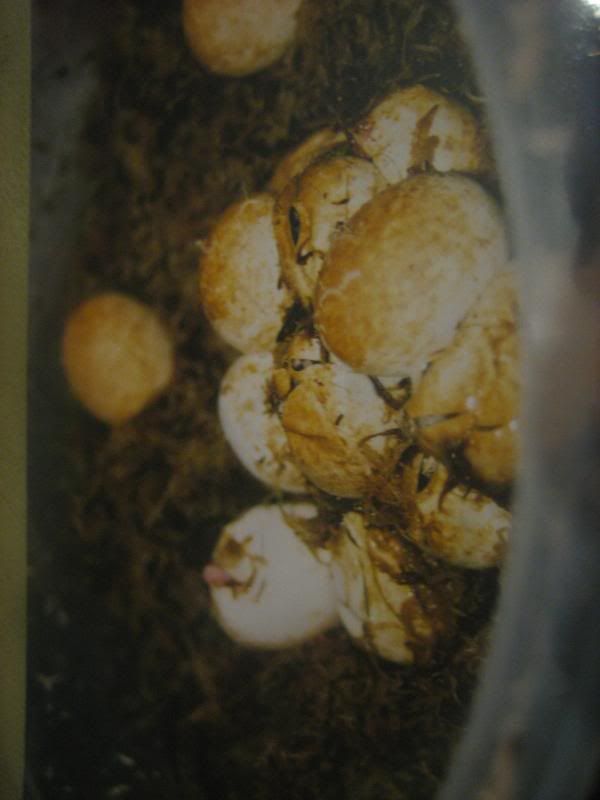
my last breeding season , i used moss in an icecream tub.

i took a large handfull, soaked it in warm water and squeezed it as dry as i could, and laid a layer in the bottom of the tub and placed the eggs on top

006.jpg


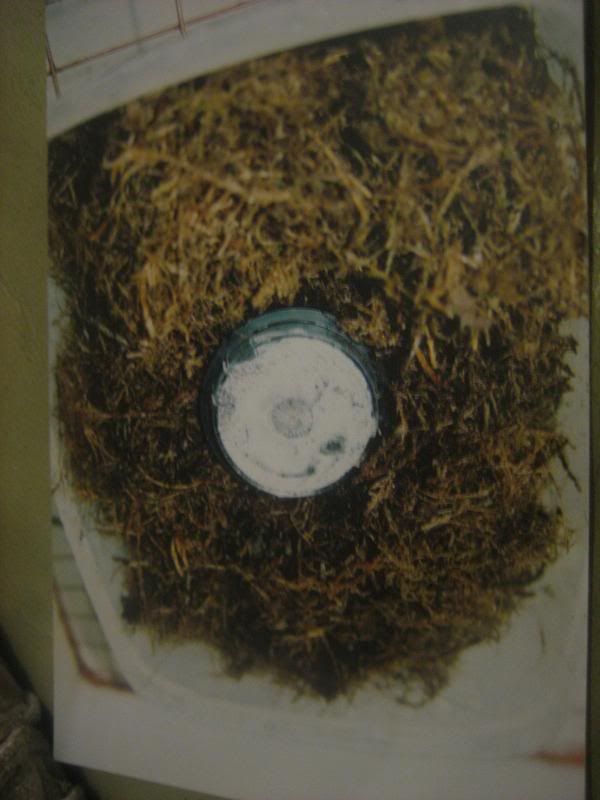
then squeezed another handfull and placed that over the eggs and placed a hydrometer on top.....

008.jpg


had 100% hatch rate........
 
I have only ever done substrateless (my thread has already been linked to), and only open up the containers once every week or two. I put them in clear containers so I can see them without needing to open them.

It's just important to provide airholes in the containers once they start pipping. Other than that. All the substrateles and near-substrateless methods are really easy and low cost.
 
I'm going that route this year. My container will be easy to see through without moss too. I just have to add a couple of airholes and cover them then I can remove the cover when they start pipping. My female should lay the end of this month-early next month. So excited! Its just a test breeding but still so fun!
 
I'm going to try the S.I.M. container with corns next breeding season. I think I'm going to either try big Styrofoam box with water and fish tank heater. Maybe a small fan to git air circulation going, wouldn't have humidity problems. In my mind this one works better. Or a dry incubation with heat pad/tape on the bottom, with a fan for circulation, maybe some bottles of water inside... Any opinions?
They seem to be fairly low maintaince, my old boss tried both (without SIM container).
 
Thanks for the thoughts, everyone. I'm leaning toward trying the medium-less incubation route. Bitsy's suggestions for making an incubator out of a box will probably also be used here at my house. The incubator I used last year was shallow, and I don't think I had enough air space in the containers. That probably contributed to the moisture issues.

I'll be sure to let you know how things play out. You guys are the best!! :cheers:
 
I've always used sphagnum moss, soaked and hand-wrung. I use the inexpensive shoebox-size containers filled about 3/4+ full with moss, loosely "fluffed" and the eggs in the middle. I do not use air-holes as the slightly loose-fitting lid, combined with my checking the eggs about one a week or two provides enough air flow and the humidity remains fairly constant throughout the incubation period. Rarely have I had to add or remove moisture like I did when I used air holes. I do not use an incubator, just set them on a shelf in my snake room which I am able to keep at a range of the mid-70's to mid-80's depending upon the outside temperature and the location in the snake room. I have also incubated in my house proper in a room that stayed around 79 F with minimal fluctuation. Cooler temps can even be used with incubation just taking longer. Once pipping starts, I check the boxes multiple times daily to remove any newly hatched snake as soon as possible. I have never had a hatchling escape an incubation container, even when I had a clutch hatch while I was at Daytona for the weekend.
 
Susan, I used the moss before but kept getting little bits of fungus on it after a couple days. Maybe I didnt wring out enough moisture?
 
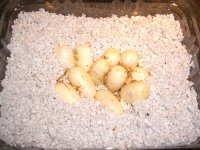
I used HatchRite, with the eggs buried nearly completely. I put an inch-deep layer of wrung out sphagnum moss over them. I used washed lettuce containers- those clear plactic boxes fancy lettuce comes in. I left the labels on top so I could write on them. They have no holes, so I opened them about once a week.

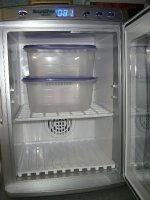
I used the ReptiPro mini-fridge incubator. I wanted an incubator that cooled as well, in case my house got too warm. I set it at 84. I monitored it with a thermometer, inside. I tried to monitor the humidity with a remote sensor, but the incubator kept killing the humidistat, so I gave up. The incubator has a tray at the bottom that I kept filled with water. I liked the incubator, and have bought a second one for this season. It doesn't hold the temp at the exact set temp. The temp varies by 2-3 degrees either way, especially on the cool side. But I'm okay with that.

A couple times during the incubation I sprinkled incubator temp water on the moss. I rotated the egg containers in the incubator every time I opened them for airing, so there wasn't one that was on the top the whole time, etc.

The incubator. (Those are not the actual containers I used- those are feeding bins).
 

Attachments

  • Incubator 001.jpg
    Incubator 001.jpg
    235.2 KB · Views: 79
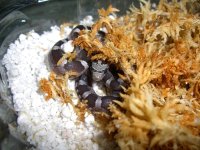
Number One, with the moss layer pushed aside for snooping. Can you believe I was so freaked out by my first hatchling, and by Buzztail actually proving out to be het anery, that I originally thought this was a bloodred? But when the little bloodred noses started pipping, I actually accepted that that really was a granite!
 

Attachments

  • Baby 01_800.jpg
    Baby 01_800.jpg
    261.6 KB · Views: 78
Susan, your set-up sounds like what I did last year, apart from putting the eggs in an incubator rather than on a shelf. Apparently I got things too damp, though, and it ended badly. Shoeboxes didn't fit into my incubator. I'm guessing that the shallower containers I used didn't have enough "head-space" for proper circulation.

Question: I know that the room-temperature method works for many. How cool is dangerously cool?

Nanci, have you used other media around the eggs? And if so, which was the most stable as far as humidity goes? I really don't want to ruin apparently good eggs again. (And yes, remembering how excited I was about my first pippie I can believe you were just that thrilled with yours!)

If I sound paranoid, it's probably because I guess I am. :shrug: I'm supposed to be able to put at least some weight on my left leg in a few weeks, but the doctor said I'll have "major restrictions" for at least 3 months after that. My small hobby collection is already a lot of work on crutches, and that will intensify with the breeding season. That said, they've never been more important to me. Thanks again for the thoughts.
 
Back
Top