• Hello!

    Either you have not registered on this site yet, or you are registered but have not logged in. In either case, you will not be able to use the full functionality of this site until you have registered, and then logged in after your registration has been approved.

    Registration is FREE, so please register so you can participate instead of remaining a lurker....

    Please be certain that the location field is correctly filled out when you register. All registrations that appear to be bogus will be rejected. Which means that if your location field does NOT match the actual location of your registration IP address, then your registration will be rejected.

    Sorry about the strictness of this requirement, but it is necessary to block spammers and scammers at the door as much as possible.

Shouldn't be this difficult!!

5 Star Serpents

Ryan and Terri
One of the latest clutches to hatch here has me a bit baffled and it really shouldn't, it's got me thrown off now I'm second guessing things that are really stupid simple! If anyone can give me some feedback on a few of these babies that would be awesome, some are just funky looking and I just want to share photos of them, others I'm just not sure.

The pairing was a JMG line Coral Ghost het Motley X Anery Motley

A few notes on the pairing:

Male was from a Ghost Motley female that I didn't have any background info on as far as hets or otherwise it appears from her offspring last year though that she is het blood however I have since passed her on and can't test her for it, Jeff Sr had used her for a project before sending her on to me. His sire is a bright pink JMG Coral Ghost ph amel

Female was sold to us as a Charcoal Motley but when we received her we suspected that was NOT right, well 3 years later we get to find out...She is in fact Anery Motley, when I originally asked the breeder what the pairing was they said "Charcoal Motley X Charcoal Motley" so I didn't get much info, and obviously what I did get wasn't correct anyways.

The obvious results from the clutch were 1 anery (D.I.E.), anery motleys, ghosts, ghost motleys and snows. Now some of the ghosts have me baffled because they have red pupils, of course my camera wouldn't focus on them so I haven't been able to get a photo of them, and this makes NO sense at all!

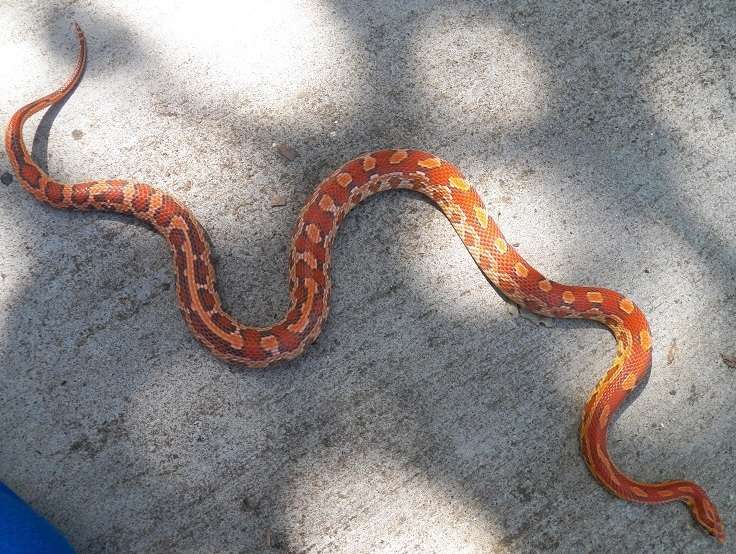
Here is a photo of the parents
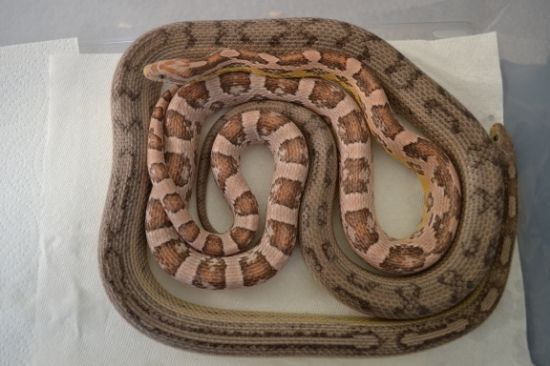
52319825-b978-4675-8667-ed0f17959a1f_zpsd0860ab1.jpg


This little snow is banded but has a fully patterned belly, so it isn't a motley, just a funky normal snow.
a9c83f57-a45c-4449-8214-94120ad0efb8_zpsae3ca82f.jpg


This little anery doesn't appear to be motley, but has no pattern on it's belly, but it doesn't seem right to be a granite either
251b18b4-9a47-4ef3-a7c4-23a8934d1581_zps48a29251.jpg

e8c9f016-33a1-4538-a938-78d50863e485_zpsea95bad6.jpg


This little snow has similar patterning and saddle shape as the anery above but it has a checkered belly, I'm not questioning anything on this one, just find it interesting is all
8bb73728-24cb-488b-820d-9fc7a262209d_zps7c25711b.jpg

99c48937-7fcb-4695-82e8-c69ae0bba304_zps5a6fc950.jpg


And a ghost that's similar to the above 2, again with a patternless belly, but doesn't seem blood or motley to me
0734cb32-01da-4b60-85f6-c8147baaef5d_zps8a1850b1.jpg

cc484364-3eb7-48d8-a024-2cd4c969e9fb_zpsa209d32f.jpg


more to come...
 
Here is a Ghost Motley baby that seems like it *might* have something more but doesn't quite seem like it's enough more.
7017e3a5-050c-42d0-a1dd-0595e2e623da_zps823e5da5.jpg

ba50e98b-6e5d-495a-adce-024aba23caae_zpseaf95ece.jpg

6f557ce9-9725-4086-a23f-c5aa1f032aa1_zps94d0d4d5.jpg


And an Anery Motley that's similar, there is another anery motley that fits in with these 2 but it wasn't liking the idea of a photo shoot.
5ac6a4e9-b240-4f6d-abca-0840db33a283_zps241acdcc.jpg

938ee2c3-cdb4-433f-adff-3049dca6a3cc_zps3a62a878.jpg

23187d29-53be-49a6-b805-a0b97147b361_zpse00c76c5.jpg


Any thoughts would be greatly appreciated, then maybe I can stop making myself crazy over thinking things :)
 
Your Coral Ghost is het for Vanishing Pattern, hence the pattern anomalies. Both are het amel and het/homo hypo. It is not uncommon to get some "color leakage" on snows and aneries in the F1 due to the Coral Trait. Now box em up and send em on down. Thanks for sharing outcomes.
 
I would say the plain-bellied "not motley" ones are actually banded motlies, hence the almost normal looking pattern. But you can see, especially on the anery one, that the saddles are sort of 'reaching' for each other in a few places, helping to indicate a likely status as a banded motley.
 
Your Coral Ghost is het for Vanishing Pattern, hence the pattern anomalies. Both are het amel and het/homo hypo. It is not uncommon to get some "color leakage" on snows and aneries in the F1 due to the Coral Trait. Now box em up and send em on down. Thanks for sharing outcomes.

So the vanishing pattern has to come from the Coral Ghosts momma, Jeff Sr was clear that the male we imported had only a slim 50% ph amel and nothing else, the ghost motley he didn't produce.

The amel hets in both and the hypo het in the female were givens, the male was hatched here so I know that he is homo hypo, which would mean the female is just an anery.
Thanks for the info on the vanishing pattern though...out of curiosity what though would cause the patternless belly on the non-motley patterned babies? I really like a lot of these babies...but I REALLY don't need more keepers since I picked up about half of the entire Roylance hatchlings from this season haha (ok maybe not half but A LOT)! I think I may be divorced if I keep too many.
 
I would say the plain-bellied "not motley" ones are actually banded motlies, hence the almost normal looking pattern. But you can see, especially on the anery one, that the saddles are sort of 'reaching' for each other in a few places, helping to indicate a likely status as a banded motley.
Thanks! There are very few banded motleys up here, I can honestly say I don't think I've ever seen one in person, it makes complete sense, do they often have that kind of fade up the sides?
 
I second the banded motley idea. Also, is it just me, or does that first snow baby look awfully short and fat?
 
I second the banded motley idea. Also, is it just me, or does that first snow baby look awfully short and fat?

It was fresh fresh out of the egg there so the belly is full of egg goop (gah it's late and proper terminology is escaping me!), I think it's just the photo about the length though, it's the same size as the rest :)
 
It was fresh fresh out of the egg there so the belly is full of egg goop (gah it's late and proper terminology is escaping me!), I think it's just the photo about the length though, it's the same size as the rest :)

lol yeah, I know the plump yolk filled bellies. Figured it might be camera angle or something. I've just recently learned about the thing called "linebacker" and from what I had read it just jumped out at me so I thought I'd ask. Now I'm kinda sad though that I rehomed my banded mot after seeing all these beauties.
 
Interesting...you have my attention, where do I find this "linebacker" I'm curious, I love learning new stuff :)

And I was trying to rush the photos so I wasn't too careful with angles and such :p
 
I've got a couple 'linebackers' that I'll be breeding together next year. One is Liam, my very first snake. The other is Nautley.

Here is a photo of Liam and Tor. Liam's the snake on the left. You can see how "thick" he is compared to Tor. He's shorter than average, and 'stocky'.

liamtor1.jpg


And while not as extreme as Liam, Nautley is also rather stocky for her size.

nautley5122.jpg
 
Dave, have I done something to anger you again?

Vanishing pattern isn't a gene, so your snake can't be het for it. It's a trait. Traits are heritable through selective breeding, but there is no predictability to it.
 
Vanishing pattern isn't a gene, so your snake can't be het for it. It's a trait. Traits are heritable through selective breeding, but there is no predictability to it.
Yep, I did know that for sure, sorry if it sounded like I was unclear on that in my response to the post, I know it's a stripe thing, just like the bright pink in the JMG line is a line bred thing, I get it completely :)


And thanks for sharing the info on the linebacker thing, we used to have a lavender male that fit the bill perfectly, he was a super chunky, stubby guy, and now that I've seen it there were actually a number of his babies that were the same.
 
out of curiosity what though would cause the patternless belly on the non-motley patterned babies?

Vanishing Pattern is the removal of the genetics responsible for producing pattern.
Because VP is a trait, the adult VP males, when bred to the "het" VP females, produce around 35-45% VP offspring. The rest are visual Coral Ghost 'classics', but those with the ziggy markings on the back stand the best chance of carrying the VP trait. While VP is based out of what several generations back was Stripe, try to keep in mind it is the removal of pattern by removal of gene, not the use of Hypo to mask visual appearance.

Also, the original line-bred classics which eventually were used to produce the first JMG CG's were part of another project to remove black pigment, but contained NO hypo. Sometimes this can throw the perfect punnet squares off the cliff into the sea of wonky. I SUSPECT Perhaps this has something to do with the visual hypos.

Even in VP clutches, with VP target achieved, some will have some stripey pattern on or near the head/neck. But then the pattern fades and disappears. Looking at motley momma, she, too, seems to have faded/absence of pattern on her sides. I see some of the babies have diminished or absent side pattern. Just an observation, again, no proof of anything.

This next paragraph is PURELY SPECULATIVE (And Nate-Bait) but I like to go round n round the motleyberry bush with this concept. We all know that motley X stripe = 100% motley. And I agree, provided that the motley parent comes from several generations of motley, and the stripe parent comes from several generations of stripe. However, IF a snake from Motley X stripe is bred to a stripe, and one of those babies is bred to a stripe, then the results become messy. Some babies are motley, some are stripe, and then there are a lot of those "other patterns" which do not fit into a neat -n- tidy classification. The ones with pairs of "= signs" running down their bodies, cubes, spots (not to be confused with Sunspot), "disappearing pattern" (not to be confused with VP), "patternless" (not to be confused with other lines in which pattern is diminished or absent). & so forth.
Heck, last year I bred a visually patternless snow stripe (she hatched that way) to a VP and got back 100% patterned offspring.
I'd take a gander that the unusual pattern on the motley momma of this clutch comes from such extraction.
A couple of those babies might be well worth holding on to, so to develop new selective linebred trait lines. The 'circlebacks' (just making up a name here) with a relatively low saddle count and near-absence of side pattern are particularly interesting.


As for belly patterns, it's a lot easier if you completely ignore them. The original male and female Tesseras have no belly pattern. I have stripes and motleys with some checks on them. As you move away from tidy punnet square genetics you will see.


I've got a couple 'linebackers' that I'll be breeding together next year. One is Liam, my very first snake. The other is Nautley.

Here is a photo of Liam and Tor. Liam's the snake on the left. You can see how "thick" he is compared to Tor. He's shorter than average, and 'stocky'.

liamtor1.jpg


And while not as extreme as Liam, Nautley is also rather stocky for her size.

nautley5122.jpg

Meg, this post is total Dave-Bait!!! Have they been X-rayed? Any chance they are non-paradox chimera's? Fully fused conjoined-in-the-egg twins posing as individuals? I ask only because some of the paradox chimeras seem to be unusually thick for their length, and X-ray gives away the secret to their sexiness. Or, is it posible that some snakes carry an extra set of chromosomes, in much the same way as "butterfly koi" do? Thread de-railing complete.


Dave, have I done something to anger you again?

Vanishing pattern isn't a gene, so your snake can't be het for it. It's a trait. Traits are heritable through selective breeding, but there is no predictability to it.

Nate, Darling, Little Miss Crabby Pants, Dear One, What is the Solution, not the issue please? What is the correct terminology for "het salmon", or "het vanishing pattern"?


Yep, I did know that for sure, sorry if it sounded like I was unclear on that in my response to the post, I know it's a stripe thing, just like the bright pink in the JMG line is a line bred thing, I get it completely :)

But, it's not a stripe thing. It's the removal of the stripe thing. Nate can tell us. Better he blow up a cerebral node then me. I'm fresh out of them.
 
Even in VP clutches, with VP target achieved, some will have some stripey pattern on or near the head/neck. But then the pattern fades and disappears. Looking at motley momma, she, too, seems to have faded/absence of pattern on her sides. I see some of the babies have diminished or absent side pattern. Just an observation, again, no proof of anything.

A couple of those babies might be well worth holding on to, so to develop new selective linebred trait lines. The 'circlebacks' (just making up a name here) with a relatively low saddle count and near-absence of side pattern are particularly interesting.

I never really actually paid much mind to momma's lack of patterning on her sides...good point as she does have rather nekkid looking sides also so that could explain a lot.

As for the second part, I *think* I told Ryan some were getting held back although I'm not sure he's terribly thrilled about it :p

I'm all for having a clear explanation of things and being able to say "this is what it is 100% no doubt, no other way, it is what it is" but at the same time there are a lot of beautiful, unexplainable snakes that I would be happy to have :)
 
You would not be wrong to hold them all back. The anery& amel ones especially. Let them color up for a year before making any decisions. Something I noticed recently is that some of the offspring of JMG Coral Ghost VP lineage have NO saddle border. Which brings us back to the linebred base classic stock which involved the removal of black from the line. Think I might have let a few get out the door last year before seeing something that wasn't there. Learning to look for what is not there, as well as what is there, and then having to develop personal definitions for traits-or-genes & stuff that hasn't been published by someone else... regardless, there is much yet to be learned, selectively line-bred & refined to produce predictable outcomes.

The wonderful thing about holding back "some" is that "all" are still "some".
 
The wonderful thing about holding back "some" is that "all" are still "some".

I think I shall make this my new motto, muhahaha.

Joking aside there are some "normal" ones who will likely be shown the door, but there are a handful that will get a special spot in the racks for a bit more of an extended stay :)

There's 24 or 25 in the clutch so I only took pics of interesting ones who wanted to cooperate, which wasn't many.
 
The solution, my dearest buddy Dave, is to stop with the use of that terminology. Instead, if I were you, I'd label your animals by project lineage. For example, let's say you're selling one of your "het" VPs. I'd label blah blah blah from my VP project.

You don't see chondro guys labeling their projects het blue or het black, because that would be silly of them, and false. Because we know you can't be het for a trait.

Also, since you decided to preemptively answer my question of predictability in traits, I'll go to the next question which is, can I see proof that a VP x "het" VP statistically produces 40-ish% VP babies? And does this math work with all your traits?
 
Hah! Humans have digital desires in an analog world.

The closer we study the genetics of the corn snakes, the more the realization should become apparent of the fractal nature of what we are looking at. We will NEVER be able to create enough cubby holes to put all of the definitions into.

For instance, at one time, there was only one cultivar known as "Amelanistic". That has now been "fractilized" (I'm sure there is really no such word as that!) into many branching forms as we looked closer and closer at the formerly simple "Amelanism" and thereby created complexity in the looking.

This will happen with everything you see now today in corn snake genetics. The closer you look, the apparent complexity only becomes deeper and more obvious, NOT reduced nor simplified.

There will never be any FINAL answers.
 
The solution, my dearest buddy Dave, is to stop with the use of that terminology. Instead, if I were you, I'd label your animals by project lineage. For example, let's say you're selling one of your "het" VPs. I'd label blah blah blah from my VP project.

You don't see chondro guys labeling their projects het blue or het black, because that would be silly of them, and false. Because we know you can't be het for a trait.

Also, since you decided to preemptively answer my question of predictability in traits, I'll go to the next question which is, can I see proof that a VP x "het" VP statistically produces 40-ish% VP babies? And does this math work with all your traits?

Well, first, let's go back and look at the "motley" which is labelled as "Motley". While she does seem to have some "Motley" "markers", those twin spots &c are sure as heck not motley. Can I make you a sandwich?

With regard to line breeding, predictability, increasing predictability through infusion of a trait via multi-generational lineage, etc, , , I've answered this in the past, on another thread you participated in, here:
Post ten, read the whole thread. Gotta love that Motleyberry bush. http://www.cornsnakes.com/forums/showthread.php?t=127606
 
Back
Top