-
Hello!
Either you have not registered on this site yet, or you are registered but have not logged in. In either case, you will not be able to use the full functionality of this site until you have registered, and then logged in after your registration has been approved.
Registration is FREE, so please register so you can participate instead of remaining a lurker....
Please be certain that the location field is correctly filled out when you register. All registrations that appear to be bogus will be rejected. Which means that if your location field does NOT match the actual location of your registration IP address, then your registration will be rejected.
Sorry about the strictness of this requirement, but it is necessary to block spammers and scammers at the door as much as possible.
You are using an out of date browser. It may not display this or other websites correctly.
You should upgrade or use an alternative browser.
You should upgrade or use an alternative browser.
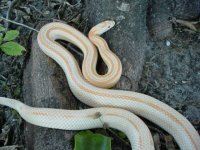
Striped Creamsicle Corn
- Thread starter StephenRoylance
- Start date


gardenmum
Hopelessly Addicted
A Creamsicle
is an Emory X Corn cross, or corn hybrid, but I also think it is considered a morph.
This is from Serps Morph page:
"There are a ton of color and pattern variations in cornsnakes. Certain looks that vary from the standard ‘normal’ look of cornsnakes, resulting from either mutations, combinations of mutations, or selective breeding, are called morphs."
And in this secttion he has Oddities which creams are listed under. So the way I take it, I would considered it a morph, but someone can correct me if I am wrong.
And I agree, that striped cream is really nice looking.
is an Emory X Corn cross, or corn hybrid, but I also think it is considered a morph.
This is from Serps Morph page:
"There are a ton of color and pattern variations in cornsnakes. Certain looks that vary from the standard ‘normal’ look of cornsnakes, resulting from either mutations, combinations of mutations, or selective breeding, are called morphs."
And in this secttion he has Oddities which creams are listed under. So the way I take it, I would considered it a morph, but someone can correct me if I am wrong.
And I agree, that striped cream is really nice looking.
gardenmum
Hopelessly Addicted
Well,
I guess that could be a topic of differing opinions.
I am by far no expert on this and wouldn't try to pass myself off as one, I just went by how I always heard it refered to and had learned it from Serps morph page; this is how he describes a creamsicle: "Many people use the name “Creamsicle” to describe any Emoryi/Cornsnake hybrid. But more specifically, the name refers to an amelanistic hybrid between cornsnake and Emoryi’s Ratsnake. The name pretty much describes the coloration."
But to me, either word works. :cheers:
I guess that could be a topic of differing opinions.
I am by far no expert on this and wouldn't try to pass myself off as one, I just went by how I always heard it refered to and had learned it from Serps morph page; this is how he describes a creamsicle: "Many people use the name “Creamsicle” to describe any Emoryi/Cornsnake hybrid. But more specifically, the name refers to an amelanistic hybrid between cornsnake and Emoryi’s Ratsnake. The name pretty much describes the coloration."
But to me, either word works. :cheers:

carol
Down with the sickness
Yes, that could get into an entirely different can of worms.... are corn X kings really hybrids if they produce fertile offspring??... and a few other offshoots we could go into. :awcrap: Hope you didn't take that comment personally! Just trying to add some info to the thread. :spinner:
Darin Chappell
Very Senior Hillbilly
"Hybrids" are the results of different species being bred, and "intergrades" are the results of pairing two subspecies. So, it is entirely based upon the taxonomy of the parent animals that determines what the babies are.
Until recently, Great Plains Rat Snakes (GPRs) were labeled as Elaph gutatta emoryi, and Corns were Elaph gutatta gutatta. So, their offspring (whether creamsicle, rootbeer, cream soda, or whatever) were actually intergrades, since GPRs and Corns were simply subspecies of the same species Elaphe gutatta.
However, it has now been determined the the identification of both animals have changed. GPRs are identified as Pantherophis emoryi, and Corns are listed as Pantherophis gutatta. Since these animals are now listed as different species, the resulting offspring from pairing them are now seen as hybrids.
The definition of "Hybrid" has everything to do with how they were derived (ie: the breeding of two animals of different species), and not the results of that derivation. So, the fact that reptile hybrids can almost always reproduce (unlike mammalian hybrids) is not enough to suggest that they are not true hybrids.
So, the correct term for creams of all types is "hybrid." But, that is only true so long as taxonomists continue to agree on which animal is part of which species. It's all a bit capricious in the end!
Until recently, Great Plains Rat Snakes (GPRs) were labeled as Elaph gutatta emoryi, and Corns were Elaph gutatta gutatta. So, their offspring (whether creamsicle, rootbeer, cream soda, or whatever) were actually intergrades, since GPRs and Corns were simply subspecies of the same species Elaphe gutatta.
However, it has now been determined the the identification of both animals have changed. GPRs are identified as Pantherophis emoryi, and Corns are listed as Pantherophis gutatta. Since these animals are now listed as different species, the resulting offspring from pairing them are now seen as hybrids.
The definition of "Hybrid" has everything to do with how they were derived (ie: the breeding of two animals of different species), and not the results of that derivation. So, the fact that reptile hybrids can almost always reproduce (unlike mammalian hybrids) is not enough to suggest that they are not true hybrids.
So, the correct term for creams of all types is "hybrid." But, that is only true so long as taxonomists continue to agree on which animal is part of which species. It's all a bit capricious in the end!

It has always been my understanding (not necessarily correct) that an "intergrade" is not only a subspecific crossing, but a requirement is that the ranges of each respective subspecies must at least make contact with the other.
In other words, an animal that is a naturally occuring combination of Lampropeltis t. sinaloae (Sinaloan Milk Snake) and Lampropeltis t. nelsoni (Nelson's Milk Snake) would be an intergrade because their natural ranges make contact in central Mexico. However a crossing of Lampropeltis t. sinaloae (Sinaloan Milk Snake) and Lampropeltis t. stuarti (Costa Rican Milk Snake) would be a hybrid because their ranges do not contact at all at any point.
Of course, the above description assumes that intergration is taking place naturally at the range overlap region. In some circles the breeding of any subspecies together in a captive situation could likely be inferred to be hybridization as well, since the animals resulting would not be from the natural range overlap of the two subspecies. Quite likely, they would not look the same as the naturally occuring intergrades anyway.
Then there are instances where animals have been discovered that appeared to be a natural breeding between something like an Elaphe o. quadrivittata (Yellow Rat Snake) and Elaphe g. guttata (Corn Snake). Although they would certainly qualify to be called "hybrids", the term lately has been more commonly used to designate animals that are unnaturally bred together in captivity.
Definitions are subject to change without notice, of course.
In other words, an animal that is a naturally occuring combination of Lampropeltis t. sinaloae (Sinaloan Milk Snake) and Lampropeltis t. nelsoni (Nelson's Milk Snake) would be an intergrade because their natural ranges make contact in central Mexico. However a crossing of Lampropeltis t. sinaloae (Sinaloan Milk Snake) and Lampropeltis t. stuarti (Costa Rican Milk Snake) would be a hybrid because their ranges do not contact at all at any point.
Of course, the above description assumes that intergration is taking place naturally at the range overlap region. In some circles the breeding of any subspecies together in a captive situation could likely be inferred to be hybridization as well, since the animals resulting would not be from the natural range overlap of the two subspecies. Quite likely, they would not look the same as the naturally occuring intergrades anyway.
Then there are instances where animals have been discovered that appeared to be a natural breeding between something like an Elaphe o. quadrivittata (Yellow Rat Snake) and Elaphe g. guttata (Corn Snake). Although they would certainly qualify to be called "hybrids", the term lately has been more commonly used to designate animals that are unnaturally bred together in captivity.
Definitions are subject to change without notice, of course.
carol
Down with the sickness
Rich Z said:
Definitions are subject to change without notice, of course.
LOL, I guess that sums the whole thing up!
Interesting point as well, Darin. I guess I was thinking that Patherophis replaced Elaphe, instead of the "first" gutatta. :dunce:
I guess it is too late to stick the lid back on that can'o worms, eh?
You know, I can remember as a kid asking someone about why the need for the Latin names for animals. I was told that was done because an animal can have MANY common names, but only one Latin name.
:crazy02: :crazy02: :crazy02:
As far as I know, there is only one type of snake called a "Corn Snake"........ I think I will stick with that. I don't see "Pantherophis" becoming a common part of my vocabulary any time soon.
:crazy02: :crazy02: :crazy02:
As far as I know, there is only one type of snake called a "Corn Snake"........ I think I will stick with that. I don't see "Pantherophis" becoming a common part of my vocabulary any time soon.

Chip
ΜΟΛΩΝ ΛΑΒ&
Too funny! I got the same answer, and there are SO many more Latin names in the herp world that one common name will clear right up. I'd have to dig deep to come up with many common names for a corn. "Red rats" was what my Dad called them, and Hobart Smith's book refers to them as "lyre ratsnakes." I never forgot that only because I tried to sound smart at around ten years old and use that word in every petshop ... no one knew what the heck I was talking about.:nope:You know, I can remember as a kid asking someone about why the need for the Latin names for animals. I was told that was done because an animal can have MANY common names, but only one Latin name.