-
Hello!
Either you have not registered on this site yet, or you are registered but have not logged in. In either case, you will not be able to use the full functionality of this site until you have registered, and then logged in after your registration has been approved.
Registration is FREE, so please register so you can participate instead of remaining a lurker....
Please be certain that the location field is correctly filled out when you register. All registrations that appear to be bogus will be rejected. Which means that if your location field does NOT match the actual location of your registration IP address, then your registration will be rejected.
Sorry about the strictness of this requirement, but it is necessary to block spammers and scammers at the door as much as possible.
You are using an out of date browser. It may not display this or other websites correctly.
You should upgrade or use an alternative browser.
You should upgrade or use an alternative browser.
Stripes and the funky Eye thing.....
- Thread starter rich333
- Start date


randj
New member
It would be ideal to know for sure that the deeper parts of the eye are normal but for that we would need a snake opthamologist! I mention this since in dogs I think that abnormal irises and pupils can sometimes accompany other eye problems. Not a problem for our pet snakes, but in the wild if it was accompanied by other problems, maybe the snake would not survive to reproduce. Mentioning this since my brain is going the direction of how people bred bulldogs because they thought them cute, but if one looks at some of their characteristics from a functional point of view, well, they aren't very! Kind of a jump from snakes to bulldogs, I know. Anyway, I just want to know that the odd pupils are not something that are accompanied by something more serious.

When.where did the first striped cornsnake come from?
My understanding is that Ernie Wagner sold some Okeetees to Europe, and someone there (sorry, name unknown) started producing stripes from that line. Apparently Ernie contracted with this person to have the stripes marketed through him here in the USA. The first person here in the USA that I personally know working with the stripes was Al Zulich in Maryland. I avoided them for the longest time because the first several generations seem to have severe survivability issues.
Up till the point I retired, I had never seen any stripes with malformed pupils in their eyes, so this seems to be a rather recent development.

Kevin S.
Active member
I've never had a corn that exhibited this (striped or otherwise), but I hatched a crested gecko with one eye like this years ago and noticed that it seemed to occur with some frequency in that species based on the number of other breeders asking about it. A vet told me that it "possibly indicates that it is a malformation of the iris or ciliary body as opposed to a mutation. Obviously it is a congenital (born-with) defect, but that doesn't always mean it is a hereditary (genetic) problem or mutation."
Last I heard, it didn't appear to be genetic in cresteds, but was assumed to be due to incubation irregularities. I don't know if the same would hold true for these corns or not.
Last I heard, it didn't appear to be genetic in cresteds, but was assumed to be due to incubation irregularities. I don't know if the same would hold true for these corns or not.
Can I point out (and yes at this point I do have my vet hat on), that we are actually looking at 2 different ocular issues here? The snake in the OP has opacities in either the cornea or the spectacles. It looks most like lipid deposits that occur occasionally in the corneas of dogs and cats (no one really knows why this happens). Obviously from a photo it is hard to be more precise than this, but you can see the outline of the pupil underneath it, not to mention the lesioon is actually a different colour than the iris.
The other snakes in the thread have iris abnormalities as already stated- why I don't know but it is OCCASIONALLY seen in other animals as a congenital issue but more often as a result of deep ocular trauma.
The other snakes in the thread have iris abnormalities as already stated- why I don't know but it is OCCASIONALLY seen in other animals as a congenital issue but more often as a result of deep ocular trauma.

Nanci
Alien Lover
From the research I was doing Friday, it seems to be a ciliary body issue in many cases, and often is a pigmented ciliary body which gives the illusion of a non-symetrical pupil.
I found out something else cool, too. Snakes are the only land-dwelling animal with spherical lenses. Spherical lenses are what aquatic creatures, like fish, have, for better vision under water. This points to snakes' probably evolution from water to land. The spherical lenses have the ability to focus (I'm not sure I knew this- I thought snakes had fixed-focal vision, for some reason) which is done by changing the shape of the lens- a completely different mechanism than that which focuses other reptile eyes.
I found out something else cool, too. Snakes are the only land-dwelling animal with spherical lenses. Spherical lenses are what aquatic creatures, like fish, have, for better vision under water. This points to snakes' probably evolution from water to land. The spherical lenses have the ability to focus (I'm not sure I knew this- I thought snakes had fixed-focal vision, for some reason) which is done by changing the shape of the lens- a completely different mechanism than that which focuses other reptile eyes.

rich333
They Are Coming!!!
Can I point out (and yes at this point I do have my vet hat on), that we are actually looking at 2 different ocular issues here? The snake in the OP has opacities in either the cornea or the spectacles. It looks most like lipid deposits that occur occasionally in the corneas of dogs and cats (no one really knows why this happens). Obviously from a photo it is hard to be more precise than this, but you can see the outline of the pupil underneath it, not to mention the lesioon is actually a different colour than the iris.
The other snakes in the thread have iris abnormalities as already stated- why I don't know but it is OCCASIONALLY seen in other animals as a congenital issue but more often as a result of deep ocular trauma.
Just wanted to say thank you..for your Professional assessment.
Ok, So..freckles has lipid deposits...not an iris abnormality, Not sure i should
be happy or more worried!
 . So,at any rate, my apologies for posting the
 pic. as she obviously doesn't fit in this group.
Side Note:
Wonder if they make contacts for snakes? Hmmmmmm.........

Isoldael
New member
Can I point out (and yes at this point I do have my vet hat on), that we are actually looking at 2 different ocular issues here?
Hah! Was wondering if I should have mentioned that
. Even though I dropped out of vet school because I missed math (yep... I'm crazy like that), we already did all the eye stuff. The first pics do look quite different!Either way, having seen this thread I decided to take a closer look at Nash's eyes. I can't quite tell yet if it's just a discolouration on his iris or an actual weird shaped iris. I'll have to try again tomorrow in proper light
Isoldael
New member
Wonder if they make contacts for snakes? Hmmmmmm.........
Nah, they only make glasses, and only for spectacled cobras :rofl:
rich333
They Are Coming!!!
Nah, they only make glasses, and only for spectacled cobras :rofl:
NICE!!!!! :cheers:

dave partington
Crazy Dave
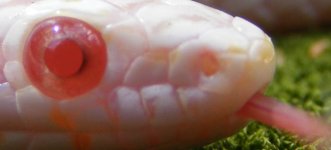
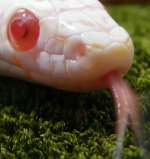
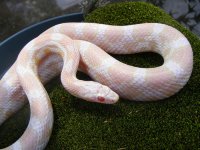
dave partington
Crazy Dave
***is the eye splotch of color an indicator of what some might describe as:
"visually het stripe" ?
"visually het stripe" ?

beautifullywild77
Go Penguins!!!
Piglet has the splotch in his eye.

I think most of my pale-eyed morphs also have that black splotch, stripe or no stripe.
dave partington
Crazy Dave
Perhaps there are genes yet un-named?

JimGERcream
German efficiency
I'd agree with rich.
on topic:
here's an extreme version of those funky eyes. Pitty these cat eyes are not specific reproducible.
just click on the link, it's a toffee caramel striped with awesome slit pupils
http://farbvarianten-lexikon.de/gal.../Caramel-Toffee-Striped_Semiadult_01_N_sb.jpg
on topic:
here's an extreme version of those funky eyes. Pitty these cat eyes are not specific reproducible.
just click on the link, it's a toffee caramel striped with awesome slit pupils
http://farbvarianten-lexikon.de/gal.../Caramel-Toffee-Striped_Semiadult_01_N_sb.jpg

SMDminnesota
New member
From the research I was doing Friday, it seems to be a ciliary body issue in many cases, and often is a pigmented ciliary body which gives the illusion of a non-symetrical pupil.
I found out something else cool, too. Snakes are the only land-dwelling animal with spherical lenses. Spherical lenses are what aquatic creatures, like fish, have, for better vision under water. This points to snakes' probably evolution from water to land. The spherical lenses have the ability to focus (I'm not sure I knew this- I thought snakes had fixed-focal vision, for some reason) which is done by changing the shape of the lens- a completely different mechanism than that which focuses other reptile eyes.
Does this mean they can't focus as well?
If it does mean they can't focus as well I can see why people try to avoid it. Yes, the animal can live a long a "normal" life but it can't see as well. Humans with albinism have different neural connections from their eyes to the sensory portion of the brain that results in reduced visual quality. I'd assume there is a similar effect in other species.
I'd love to see more information/research on this, especially since stripe is my favorite trait. It might not be as blatant as the stargazer but it may be a reduced life quality affect. All that being said there was that ball python that was hatched without eyes at all, and Steve Roylance hatched a two headed corn. Both have a normal domesticated life. I guess it boils down to which defects we deem are acceptable.
Fascinating stuff!