• Hello!

    Either you have not registered on this site yet, or you are registered but have not logged in. In either case, you will not be able to use the full functionality of this site until you have registered, and then logged in after your registration has been approved.

    Registration is FREE, so please register so you can participate instead of remaining a lurker....

    Please be certain that the location field is correctly filled out when you register. All registrations that appear to be bogus will be rejected. Which means that if your location field does NOT match the actual location of your registration IP address, then your registration will be rejected.

    Sorry about the strictness of this requirement, but it is necessary to block spammers and scammers at the door as much as possible.

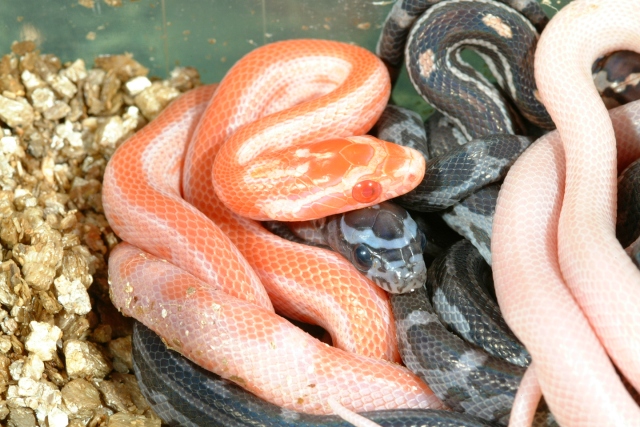
Tiger Corn??

Well, it's definitely unusual! I always get a bit squimish about stories that start off . . ."A friend/co-worker of mine got this female, but I don't know all the details . . ." I'm not saying it's all a big lie, but I wish people could get their facts straight before trying to introduce something for critical review.

Also, assuming for the moment that the striping is actually a genetic trait, it is not purely dominant. If it were, then all of the babies would be showing the striping instead of just one or two of them.

Also, I am a little bothered about this female only laying four eggs one year and only six the next. She was over three feet long, and laying only a few eggs at a time. I know of intergrades and hybrids that lay fewer eggs than the average corn, and some corns just lay fewer eggs at a time. However, that is a LOT fewer eggs for cornsnakes, and it causes me to wonder about the snake being pure corn.

The page isn't done yet, but those are my initial thoughts and concerns on the question. Anybody else?
 
I agree with you Darin, at least it didn't start off "I heard it from a friend who heard it from a friend who heard it from another" ;)

Something just seems a bit odd about the whole story and the amount of eggs....but hey what do I know?
 
Also, assuming for the moment that the striping is actually a genetic trait, it is not purely dominant. If it were, then all of the babies would be showing the striping instead of just one or two of them.

Actually, if a trait is dominant, it is expressed in the heterozygous form. If it is PURELY dominant, then the homozygous form and the heterozygous form should look the same (much like the dominant "normal" gene partner to most of our known morphs). If it is only partially dominant, then you stand the chance of the homozygous form having more of an effect than the heterozygous form....hence "tigers" (hets) vs. "super tigers" (homos).

Assuming the female is heterozygous for some dominant "tiger" gene, then statistically 1/2 of the offspring would be "tiger" and half normals (who don't carry the gene).

If the snake was homozygous for the dominant "stripe" gene, then yes, all offspring would be normal.

("tiger" in quotes as a hypothetically dominant gene)
 
Hurley,

You are absolutely correct! Without even considering other options, I made the baseless assumption that the female was a homozygous carrier of the gene. If she were a het, and the gene were truly dominant, then half of her babies would be het carriers and half would be normals.

Thanks for catching that!

I have to admit that the egg count still bothers me, though...
 
Maybe it's just me, but when I heard the name "Tiger" Corn Snake, I had a visual of a corn with pinstripe bands down the body. Kind of what you would see in the pattern of a REAL tiger.

Maybe I've just been living in the woods too long, but has anyone ever seen a Tiger (Panthera tigris) with a full stripe down the back? Or is this a play on words with the genus name?

Interesting looking animal, but is the name really appropriate for what it looks like? My belief is that if the name doesn't help describe the genetics involved in the animal, at least it should help describe what it looks like.
 
Hope I'm not being to daft!

Okay I understand genetics like I understand rocket science (and I'm and architect-student), but without trying to sound to daft, this tigersnake thing looks like a bit of a motley to me.

My knowledge of genetics and morphs are bound to seprwidgets site so... But it really looks like an amel form of the snakes featured there as motleys?

Possible or should I stop smoking cornsnakedung?
 
The problem is that, thus far, the motley pattern mutation has thought to include the white belly/no checks pattern as well. The animal in the picture, while looking motley-ish on the dorsum, the ventral side looks like something else entirely.

Now, it has been speculated that the two sides of a motley are actually controlled by two separate, yet closely connected genes. If so, it may be that those two genes have come apart in the animal in question. If so, a simply breeding trial might set things straight.

Who knows? . . . It's an interesting animal regardless!
 
Regarding the motley/plain belly genes, remember this post? The top of the snake looks motley (at least non-normal), and has a normal looking underside. Maybe that's what's happening.

Re: the name 'tiger', I they borrowed the name from tiger retics, where the gene also causes striping down the back. At least the tiger retic has 'tiger-like' colors (mostly yellow and black)

I'm uncomfortable with them naming a new mutation that closely resembles something we already have (stripe/stripe motley) without doing breeding trials to see if it might be compatible.
 
From the post you refer to, I'd say it sounds a bit like the same story, mmmm...

Would be nice if this could be reproduced!
 
The "tiger" corn just may be a variant of the zigzag gene(s). It would account for both the ventral checks and the appearance of both normal and patterned hatchlings. The smaller clutch size as well as the smaller hatchling size could also be associated with this pattern, as one of my lines of zigzags is known for small clutches and small hatchlings. This amel zigzag does show a partial "tiger" stripe, and, with selective breeding, this may result in a full body stripe we see on the other snake. Just a thought.
 
A similar sort of trait seems to show up now and again around here.

I have traced back the original source to a particular Blizzard corn I have as the ancestor to all examples I have had so far. I kept back a few Blizzards with this pattern, but it does seem to be a waste of a striped pattern in a Blizzard!

amelstripe61.jpg
 
Rich,
That looks just like the white-sided rats that are poping up every where now. I have to admit I like that one! If you ever decide to get rid of those please drop me a line! :D


Ken
 
I think until they've bred it to any traits that could be alleles (motley/stripe/aztec/zigzag, and even bloodred) there's no grounds for claiming it's "new."

I also don't see how "breeding it to a wild-caught" is some sort of magic wand which eliminates all possibilities of hatching morphed offspring.

Best I could tell, it was only ever bred to one male. They also don't mention what else that male was bred to, which may or may not be relevant.

There's about 101 possible explanations, only one of which is "it's a 'tiger' gene like in Retics." (I agree, the name makes NO sense, hehe.) Sure, it seems likely, but I don't see how any number of other possibilities are so unlikely that they should all be ignored.

I also don't see how they can claim it's either dominant or codominant. They haven't proven whether the female is even het or homozygous for "it" because they still haven't eliminated the possibility that it's recessive. ("we bred it to a wild-caught..." **facepalms**)

What I mean is: if it's dominant, and the female is het, then half the offspring would look just like her. If it's codominant and the mother is het, then half the offspring would look just like her. (And on the outside chance the male is het and it's a simple-recessive... guess what half the offspring would look like. ;))

I'm not saying it's all BS. It looks like it is heritable, so far. But I don't see any real work going toward determining what's actually happening. Instead they've just assumed that it's exactly what they want it to be.
 
Aren't there any tests you can do from bloodwork or are morphs a bit harder than that.

I don't mean like DNA testing, but something?
 
Bery interesting and a nice lloking snake. However, the first thing id like them to do is change the text on that sight. My eyes are rotating in their sockets!
 
whats even more scary is that here in the uk someone up country is selling "tiger" corns already - and i am betting there just stripe/motleys, and guess what there far more expensive than normal pattern morphs hmmmmmmm
 
I thought Tom Chaing coined Tigers

He breeds some Okeetees that he calls Tiger Corns. I'm assuming it's because they can have real thin blotches that resemble tiger stripes going down their sides. I sort of thought the name was appropriate for that phase.
 
How to contact them?.....

I followed the opening link but found no info on how to contact these folks.
Does anyone know if they have a web site or an e-mail?

Thanks!
 
Back
Top