-
Hello!
Either you have not registered on this site yet, or you are registered but have not logged in. In either case, you will not be able to use the full functionality of this site until you have registered, and then logged in after your registration has been approved.
Registration is FREE, so please register so you can participate instead of remaining a lurker....
Please be certain that the location field is correctly filled out when you register. All registrations that appear to be bogus will be rejected. Which means that if your location field does NOT match the actual location of your registration IP address, then your registration will be rejected.
Sorry about the strictness of this requirement, but it is necessary to block spammers and scammers at the door as much as possible.
You are using an out of date browser. It may not display this or other websites correctly.
You should upgrade or use an alternative browser.
You should upgrade or use an alternative browser.
Interest in locality corns.
- Thread starter jkgeorge
- Start date


MysticExotics
(formerly NWHeather)
Ooooh. Thanks Buzz and Nanci, that clears it up rather a lot. So if, in a year or so, Sphinx still displays Alabama coloration, we will be able to say that he is an Alabama phase then, yes? That makes sense, since I'm reasonably certain that he didn't come from wild-caught stock.
Thanks for your help, guys!
-- Kaifyre
Not many people are working specifically with Alabama lines, so it's likely yours is just a pretty wild type normal. I've seen a number of wild type normals that look very similar to Alabama's that are not Alabama locality.
Also, I had very little experience with breeding Alabama's, but from what I have seen, when pairing an Alabama locality snake with a non Alabama locality, the babies look more like standard normals, but they can display some of the characteristics of the Alabama parent, like the thick borders that my babies had.
Here is the thread for my Alabama x Tesserahttp://www.cornsnakes.com/forums/showthread.php?t=113919 clutch from two years ago.
I have noticed that Alabama crossed with something else tends to create babies with more of a tan ground color, as you can see it developing in the Aztec patterned baby near the end of the thread.
She went to a local friend of mine, so I will see about getting some updated pics of her.
But to answer your earlier question, no, you will not get a percentage of Alabama babies, nor can they be "het" for Alabama.
Yeah, I figured as much, since most every corn snake morph is recessive to the normal color/pattern. Just wondering if anyone had done any breeding trials with the locality morphs, I think they're all very pretty and refreshingly "wild" when compared to the more "domestic" morphs like Citrine, Orchid, etc. Every once in a while it's nice to see a wild-type : )
And that's a pretty neat progression, that Aztec baby is killer!
Thanks for the help!
-- Kaifyre
And that's a pretty neat progression, that Aztec baby is killer!
Thanks for the help!
-- Kaifyre
MysticExotics
(formerly NWHeather)
Locality snakes are normals, for all intense purposes, they just differ in look from region to region. Miami's are "normals" they just tend to have the grey or tan ground color (you mostly see grey ground color on Miami's). Alabama's are "normals" they just have a specific look.Yeah, I figured as much, since most every corn snake morph is recessive to the normal color/pattern. Just wondering if anyone had done any breeding trials with the locality morphs, I think they're all very pretty and refreshingly "wild" when compared to the more "domestic" morphs like Citrine, Orchid, etc. Every once in a while it's nice to see a wild-type : )
And that's a pretty neat progression, that Aztec baby is killer!
Thanks for the help!
-- Kaifyre
Buzz is working on creating some morphs in the Alabama line, like Amel & such.
Just like Carol has worked on creating various morphs in the Miami lines.
Locality snakes are not morphs, in the sense that a snake can be het for the gene. Locality is just the area that they came from.
It can all be confusing, I know.
MysticExotics
(formerly NWHeather)
*facepalm*
Sigh. This is what happens when I don't proofread. Should have said locality types or something ; )
-- Kaifyre
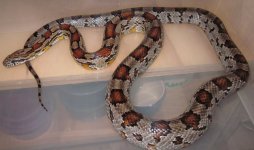
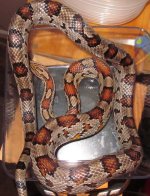
No worries. When I first saw my first Alabama (Mica) I was sure she was some sort of Miami phase, because of the silver/grey ground color.
She still is & probably will be, one of my all-time favorite Cornsankes.
She resides with Buzz & Jaime now, to continue the Alabama projects.
I miss her, but she's so stunning, she needs to be part of an Alabama project.
These are a couple of the last pics I took of her.
Attachments

Carpe Serpentis
Hybrid Snake Lover
Okeetee phase locality Okeetee line bred and improved.... is that right if one wants to breed Okeetee Okeetee so to speak?

dave partington
Crazy Dave
I think he's referring to the link I posted. A couple years ago I showed some Anery cornsnakes which came out of an Okeetee Anery A+B+Amel breeding program, which looked like Okeetee in pattern but not in color. I believe it was Susan that suggested I refer to them as "Okeetee Phase", because selective breeding and holding back of the thick saddle borders. But at this point, they are so far removed from any pure Locality type. Alternately I have some F1 Miami Locality X Cinder, which have that wonderful slate gray background color. They look like some sort of Miami but the saddles are bright red. I think of them as 'Miami Phase'.
I like Locality Types very much, and where breeding programs are concerned, think of them the same as I would a gene for punnet calculations, for personal target/goal purposes. For Miami for instance, how would all of that wonderful gray base color translate through a breeding program to an F2 amel, or F2 charcoal. Would it make the f2 base color lighter than most amels, or darker than most charcoals?
I like Locality Types very much, and where breeding programs are concerned, think of them the same as I would a gene for punnet calculations, for personal target/goal purposes. For Miami for instance, how would all of that wonderful gray base color translate through a breeding program to an F2 amel, or F2 charcoal. Would it make the f2 base color lighter than most amels, or darker than most charcoals?
Carpe Serpentis
Hybrid Snake Lover
What ???
What I am trying to say, is what would one call it if one bred locality Okeetee for Okeetee phase and selected or improved on the desired traits only using Okeetee locality found snakes or is this not done?


Nanci
Alien Lover
What I am trying to say, is what would one call it if one bred locality Okeetee for Okeetee phase and selected or improved on the desired traits only using Okeetee locality found snakes or is this not done?
I guess if I caught orange and black snakes in Jasper County, I would call them Jasper County localities, and if I then selectively bred them for thick black borders I would call them Jasper County Okeetees, and if I then selectively bred them for completely black saddles I would call them Jasper County Extreme Okeetees, as long as I had never introduced outside genes. I think the moment you introduce other than WC genes, you should lose the locality designation.


Walter Smith
CRAZY BOUT' CORNS !!
I hate to revive a thread, but I am very pleased to say that, thanks to a friend, I have been able to add a KY locality corn to my collection.
Love the golden yellows it seems to have...
I agree, VERY nice coloration......LOVE IT !!
Walter
:crazy02:BOUT' CORNS !!