• Hello!

    Either you have not registered on this site yet, or you are registered but have not logged in. In either case, you will not be able to use the full functionality of this site until you have registered, and then logged in after your registration has been approved.

    Registration is FREE, so please register so you can participate instead of remaining a lurker....

    Please be certain that the location field is correctly filled out when you register. All registrations that appear to be bogus will be rejected. Which means that if your location field does NOT match the actual location of your registration IP address, then your registration will be rejected.

    Sorry about the strictness of this requirement, but it is necessary to block spammers and scammers at the door as much as possible.

Visually identifying hypo in amel based morphs.

Tom Tuttle

Fightin the C
Has anybody been able to identify homo hypo amel based morphs without test breeding?:shrugs: Ultramel aside: I've always been under the impression that amel masks hypo and the only way of identifying is through test breeding.

:confused: Lately I've noticed ads for hatchling hypo snows, hypo fires, hypo opals and other amel based combines. How are these hypo-amel mutants being visually distinguished from the other amels within the clutch?
 
Last edited:
I didn't know my hypo avalanche stripe Pepper was homo hypo (or even het) until I bred him to a hypo bloodred and produced a ghost bloodred stripe in his first season. I waited until a second clutch was hatched, also with zero non-hypo animals (granites or bloodreds) to label him as homo hypo. Anyway- that's why my fire and avalanche hatchlings are advertised as homo hypo- because of 30 hatchlings produced with zero bloods or granites. Visually? Maybe the avalanches are pinker. Maybe the fires are orangier. Not enough to say for certain, that's for sure...
 
Hopefully, like with Nanci's situation, these hypo-amels and hypo fires are from pairings such as two hypobloods het amel.
 
Hopefully, like with Nanci's situation, these hypo-amels and hypo fires are from pairings such as two hypobloods het amel.

Hopefully but when I see hypo-amel combines and amel combines in the same ad it is very suspicious.

So far I haven't been able to visually differentiate any of my homo hypo amel combines from non hypo amel combines in adults or hatchlings.
 
With my single digit sample size, hypo amel striped bloods are certainly more orange than regular amel striped bloods. Granted the sample size is small enough to mean nothing, but would seem worth investigation.
 
Yeah, I don't see any way possible to tell them apart visually. This is no different than some people "claiming" they can see a visual difference in a hybino Honduran milk vs any other amel Honduran. If there happens to be any visual difference between them, it is purely coincidental and is simply a typical variation just as with most individuals. There is no way to visually see a reduction of melanin (hypo) in the complete absence of melanin (amel).

There was a very misinformed sole in a video posted just the other day on the KS milk forum claiming the lighter orange rings (RBR) and the yellow-ish colored outer triad rings were the visual differences between a "hybino" and an amel....HAHAHA!!! :laugh:

It is the very same thing with a cornsnake as well. The yellowish outer triad rings this guy was talking about were just another very typical coloration seen in many standard amel Hondos and other amel milksnakes, as well as amel kings such as certain amel L.ruthveni in the hobby due to certain individuals having a greater genetic predisposition for carotenoid retention in the xanthophore pigment cell layer as they mature.

This was my reply post regarding his gross misinformation.

The ONLY way to know if you have a hybino (amel x hypo) is from KNOWING the precise genetics (both visual and recessive genes) of each parent, and then see what they produce from doing a very strategic breeding combination.

A perfect example of this would be the breeding that Rusty Green carried out to produce my 100% KNOWN "hybino" that is also 100% het anerythristic as well.

Here is the scenario that proved this "hybino" out with absolutely 100% certainty. The precise outcome is in bold. In this strategic breeding, ANY amelanistic produced in this clutch would be a masked hybino/100% het anery...

Not only did he prove with absolute certainty that the amel was indeed a hybino 100% het anery, but he also produced a known triple homo "pearl" in this very same clutch because of this very strategic breeding he carried out. This was because ANY snow produced here would be a masked triple homo "pearl".


Male is, Ghost, het for amel

Female is, Hypomelanistic, Het for Snow

Offspring are predicted to be...

25.00%, Ghost, Het for Amel
25.00%, Hypomelanistic, Het for Snow
12.50%, Snow, Hypomelanistic (pearl)
12.50%, Ghost
12.50%, Amelanistic, Hypomelanistic (hybino) Het for Anery
12.50%, Hypomelanistic, Het for Anery

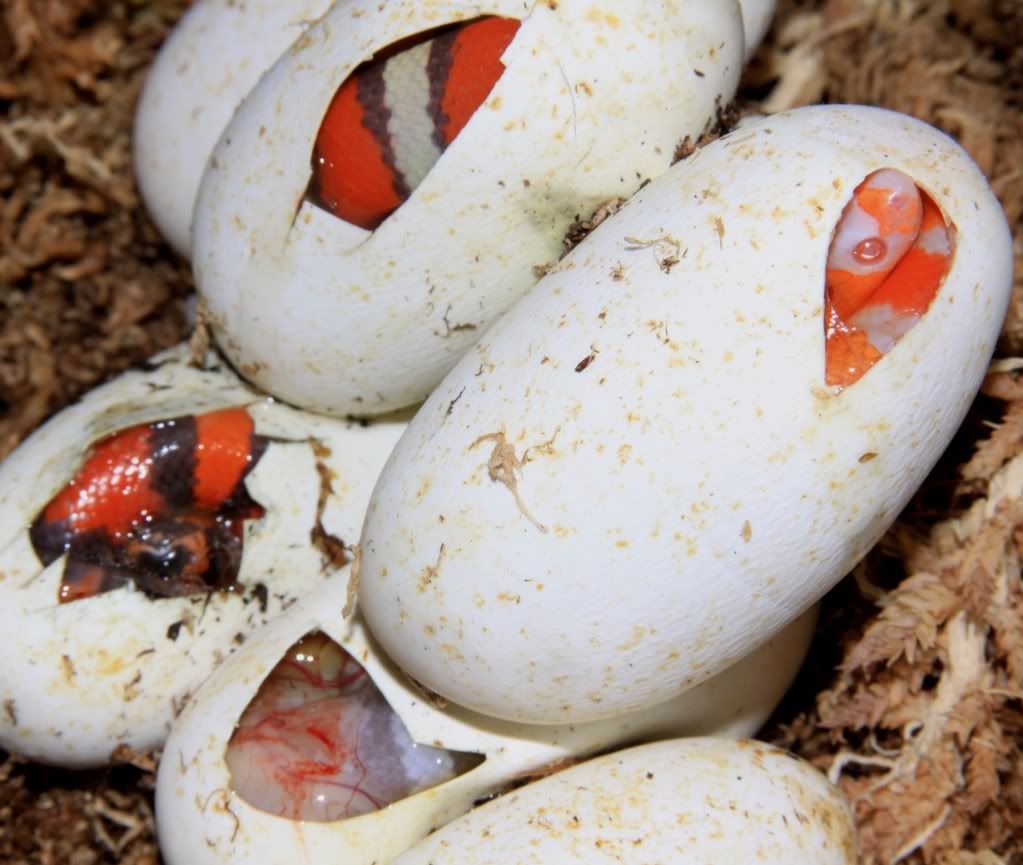
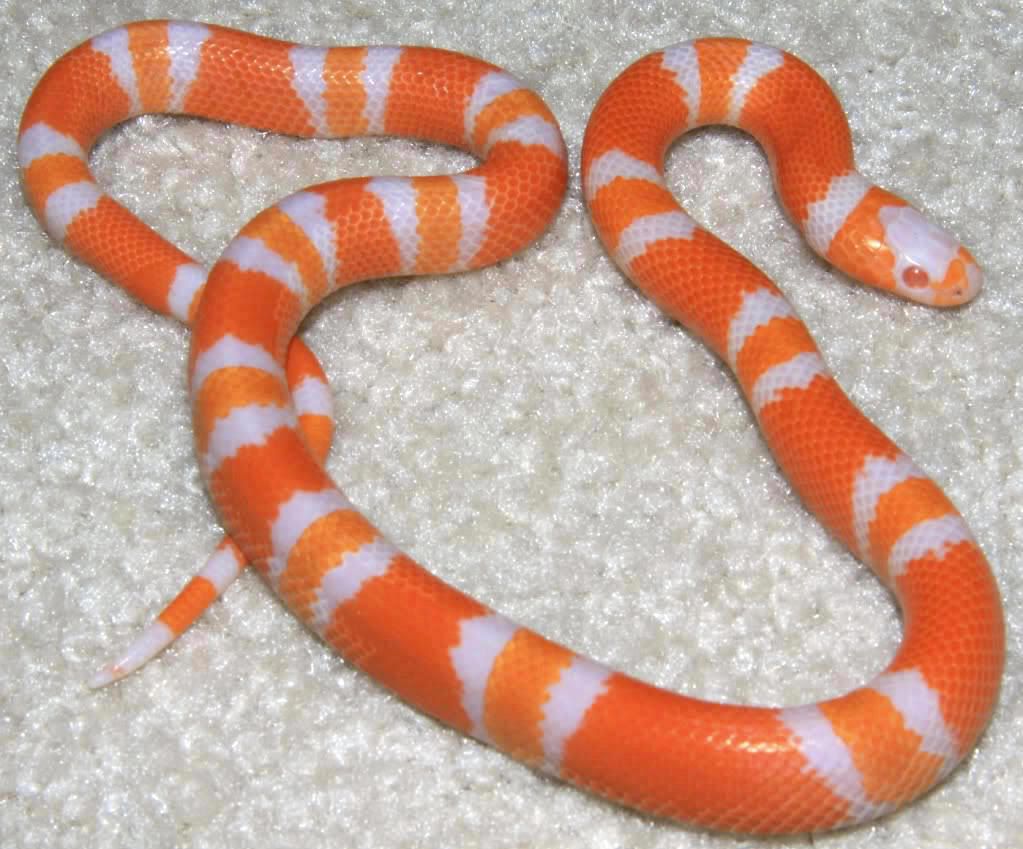
Here is the proven hybino on the right. The proven pearl is still in one of the eggs in this photo.

clutch-1_10-25-20101.jpg


3rd_HybinoHetAnery1.jpg
 
Good Post Tom

I have never seen a visual difference between them,I would think that if brighter colors or anything else would be from the line and makeup of the original animals that were used for the project.
 
From what I've seen,
there seem to be two versions of sunglow;
one's which are hypo and those which are not.
In either instance the white is entirely missing on their dorsals.
Only by placing them side by side can I sometimes get a clue as to which is which.
I assume this thread is regarding Hypo A specifically.
In the instance of lava, one just has to raise them out for about 8 months to figure out if the saddle borders go dark purple or whatever, depending on if they are carrying other hets or homo genes, all of which tosses a few more wrenches in the gears.
With hypo sunglows, they seem to be visually glossier.
As Nanci said with Hypo Avalanche, I suspect that on Ian's the difference between a "Coral Avalanche" and an Avalanche, is that the Coral Avalanche is homo hypo.
Within the snows, the addition of Hypo sometimes causes some greenish coloration between 8 months & 2-3 years of age, but not always. And then sometimes (often) the greenish coloration goes away at maturity.
I also have amels which are super glossy but have white on their dorsal, so they appear to be "very het for hypo", and when bred to hypo produce more then 50% but less than 100% hypo offspring, so I'm still not entirely sure if hypo is as predictable as the corncalc "Mathematical Possibility Predictor" shows us.
But getting back to hypo amels, at hatching, who knows, they need to go through some sheds for around 6 months, because sometimes the white speckles stay, other times they disappear.
So maybe this was another pointless post of mine. I'll just be sitting over here on the time-out bench pulling my hair out over it with some of the rest of you, or clenching my hands together and hoping real hard someone else comes along with a better answer.
 
First darn fine looking Honduran morph pics Doug...Smooth looking and/or near non-existent borders was said to be one way to tell, at least between amel and amel hypo clutchmates :shrugs:.

The very definition of "hypomelanism" and "amelanism" would lead ya to believe thast you can't have reduced melanin when there is none to reduce.

(Obvious alert)

Seeing what else, if any difference to a corns color and/or pattern hypomelanism has (and we're only talking about good old type A) would be key to determining visually whats amel vs whats hypo amel...you'd think ;)
 
I have never seen a visual difference between them,I would think that if brighter colors or anything else would be from the line and makeup of the original animals that were used for the project.


that's right,.......then there would be someone that had a different line and compare them side by side with another and say...."see the difference?" :headbang:

When in fact the "difference" would be nothing more than it being a different individual that just so happened to look slightly different because.....well, it IS a different animal..LOL!!


~Doug
 
First darn fine looking Honduran morph pics Doug...Smooth looking and/or near non-existent borders was said to be one way to tell, at least between amel and amel hypo clutchmates :shrugs:.

The very definition of "hypomelanism" and "amelanism" would lead ya to believe thast you can't have reduced melanin when there is none to reduce.

(Obvious alert)

Seeing what else, if any difference to a corns color and/or pattern hypomelanism has (and we're only talking about good old type A) would be key to determining visually whats amel vs whats hypo amel...you'd think ;)

Thanks Chris!....

Yeah, there are just too many variables that due to other things that have nothing to do with hypomelanism OR amelanism. What's even funnier about the one guy in the novice video claiming the white outer triad rings were yellowish in a hybino is the fact that my PROVEN hybino is pure white still at over two and a half!............ooops!, there goes that scientific theory....;)


~Doug
 
that's right,.......then there would be someone that had a different line and compare them side by side with another and say...."see the difference?" :headbang:

When in fact the "difference" would be nothing more than it being a different individual that just so happened to look slightly different because.....well, it IS a different animal..LOL!!


~Doug

Don't bang your head because of me! I agree! When I didn't _know_ for sure, just knew my male was at least het hypo, there was some speculation about were the brighter animals hypo. Or was it just individual variation? Then the following year the answer became obvious.
 
Don't bang your head because of me! I agree! When I didn't _know_ for sure, just knew my male was at least het hypo, there was some speculation about were the brighter animals hypo. Or was it just individual variation? Then the following year the answer became obvious.

No, I wasn't referring to what you personally stated in your post at all. I was simply pointing out what can and often does happen. We all know that what might sometimes "seem" significant, isn't necessarily the case.


~Doug
 
Back
Top