• Hello!

    Either you have not registered on this site yet, or you are registered but have not logged in. In either case, you will not be able to use the full functionality of this site until you have registered, and then logged in after your registration has been approved.

    Registration is FREE, so please register so you can participate instead of remaining a lurker....

    Please be certain that the location field is correctly filled out when you register. All registrations that appear to be bogus will be rejected. Which means that if your location field does NOT match the actual location of your registration IP address, then your registration will be rejected.

    Sorry about the strictness of this requirement, but it is necessary to block spammers and scammers at the door as much as possible.

If kinking isn't genetic . . .

How and what exactly did you / do you guys supplement with?
I use two different items. When I was doing it, and will resume doing it, I would give vitamins (just a regular old vitamin like Repti-min or some such) one month and Nutri-Bac another. Therefore, their supplements would come bimonthly. It was nothing scientific, neither is "dusting" crickets was my thought, and I would just put an eyeballed amount of powder into a container and add water. Shake to dissolve. The Nutri-Bac dissolves really well, the vitamins . . . not so much. :)

I use a big@## syringe with a larger guage (can't remember off-hand what size) needle. Suck up the liquid juice and inject about 1 cc, more or less, into a thawed mouse. For the smaller snakes getting pinkies/fuzzies/hoppers, I'd inject just enough to "bloat" the food item.

Why the injecting you ask!?!?! Nutri-Bac especially is very very . . . did I say very? . . . sticky. I've found that injecting in that little triangle above the chest cavity below the neck down into the chest cavity itself is the better method to use and the fluids tend to say in the abdominal area. You do get some leakage of fluids depending on how full you fill them. ;)

Hope that helps,
D80
 
I put them in a deli cup in the fridge overnight, and then the freezer the next morning.
D80

Brent, I've wondered how I would euthanize and thought that putting them in the fridge first would be more humane. Considering they are cold-blooded, it would put them into a kinda comatose state first so that pain would be minimized from the freezing later on. [It is my understanding that the rapid formation of ice crystals in the blood before expiration could indeed cause some unneccesary pain]. I haven't had to do this, but your method makes the most sense. Thanks for confirming my thoughts on this. I was apprehensive about the best way to do it until now.
 
If I HAD to euthanize and snake for some reason, I would probably do it the same way I plan on euthanizing the mice. A Co2 chamber. Isn't that the only "approved" method of euthanizing them? Doesn't that mean that the same would apply to the snakes themselves?

Maybe you can shed some light on this: Is this more difficult to do with reptiles? I mean, I know they can hold their breath much longer than mammals... what do you think?
 
I wondered this as well, on a side note we had our one legged beardie pts recenlt (broke my heart) and we were told that even though she checked his heart to see if it stopped we had to put him in deep freeze first. But surely putting then straight in the freezer is a really painful way to go?
 
If I HAD to euthanize and snake for some reason, I would probably do it the same way I plan on euthanizing the mice. A Co2 chamber. Isn't that the only "approved" method of euthanizing them? Doesn't that mean that the same would apply to the snakes themselves?

Maybe you can shed some light on this: Is this more difficult to do with reptiles? I mean, I know they can hold their breath much longer than mammals... what do you think?

I think (don't know from experience) that it would be quite different when comparing warm blooded and cold-blooded animals. A snake’s rate of respiration and metabolism is very slow compared to a mouse. When introduced to CO2, a mouse will go to sleep within seconds. I think a snake would take a very long time. On the other hand, reptiles are very sensitive to temperature change and would slow down drastically in the refrigerator. Slow down to the point of comma. Again, this is me guessing, I would think a snake would become unaware of himself very quickly with cold temperatures.

The upside to this conversation is that the need to kill a snake is very rare and 99% of snake owners will never find themselves with a need to know any of this.
 
As far as kinking after the fact, I'm sure constantly trying to escape deli cups plays a part as well.

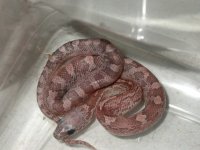
I wasn't aware they could kink after hatching. My Lav Blood clutch had 18 hatch successfully. All the Normals and Bloods hatched fine. I had three that were kinked, one Lav and two Lav Bloods including the prettiest hatchling of the lot pictured here.

The reason I quoted you Carol is because the one Lav Blood looked perfectly normal until two weeks later. Now there's a slight kink right around the vent. Is it possible it happened after hatching? Could I have done it popping her?
 

Attachments

  • 2008-Clutch #1_LavBlood 022.jpg
    2008-Clutch #1_LavBlood 022.jpg
    110.8 KB · Views: 61
If I HAD to euthanize and snake for some reason, I would probably do it the same way I plan on euthanizing the mice. A Co2 chamber. Isn't that the only "approved" method of euthanizing them? Doesn't that mean that the same would apply to the snakes themselves?

CO2 is not a good option for reptiles. Yes, it is the recommended method for small mammals, but reptiles aren't mammals. As Wade described, they have a completely different system which will result in a longer, more painful suffocation then compared to rodents.

The "preferred method" (not "approved") per some veterinarians is the injection of barbiturates (how cats & dogs are put to sleep). This option is only available if one was to take a reptile to a vet, which isn't an option for most if they have to put several hatchlings down (or they do not have an Exotics vet on hand).
 
Back on topic to the kinking- Just how common is it? I have noticed from this thread the people with most experience with it seem to also be dealing with a higher volume of eggs, and in some cases dealing with newer morphs. I am not saying this is the case but it's the impression I get.
For those of you that had kinked hatchlings, could you give a ballpark number what kind of a ratio is it? Is it like 1 in 100 or so? I'm just asking because it hasn't happened much to me and I have never done more than 5 pairings in one year... unless you count second clutches. I HAVE noticed a higher rate of both DIE and small, reluctant feeders in second clutch babies and had to euthanize more second hatch babies. As a matter of fact this year I won't even be incubating any second clutch eggs, I have already thrown one out...Could be because the mom's resources are depleted for their second time around? I am definitely going to look into nutritional supplements for gravid females.
 
I think Jen has some good points. Second cluch babies are often smaller, less hardy. It makes sense that a tired depleted mother would contribute to that.

I don't think kinking is really common. I have had probably a total of 10 kinkers over the years. It would make sense that the more eggs you hatch the more likely you are to get one. I'm sure Rich Z has seen more than I.
 
I had a very, very small breeding season this year due to being preggo...About 100 or so eggs...I had 2 kinks and 1 DIE.

Last year I had 15 or so kinks (10 or so of which were from a single clutch of Lavender Motleys)...and I'd have to dig for records on how many were laid that year.

I also don't double clutch, so the double clutching isn't a factor with mine.
 
It wasn't deliberate that I ended up with second clutches this year...I did not rebreed them. Three out of five of my girls this year have had second clutches - two are in nest boxes right now. Luckily the one female I really didn't want to have a second clutch - she looked so skinny! - did not. I have been having to give her pinkies, after first becoming gravid she began refusing f/t with any fur at all. She will eat live, so she also gets the culls from my mouse colonies. (She's the female that gave me the blue eyed vanishing stripe ghost, so I guess she gets to be a prima donna.)
I did rebreed a few females last year, and while I had OK results I really feel it's asking too much of them.
 
I wasn't aware they could kink after hatching. My Lav Blood clutch had 18 hatch successfully. All the Normals and Bloods hatched fine. I had three that were kinked, one Lav and two Lav Bloods including the prettiest hatchling of the lot pictured here.

The reason I quoted you Carol is because the one Lav Blood looked perfectly normal until two weeks later. Now there's a slight kink right around the vent. Is it possible it happened after hatching? Could I have done it popping her?


Yes, they most definitley can develop kinks after hatching a variety of different ways and sometimes for no apparent reason. :(
 
Back
Top