• Hello!

    Either you have not registered on this site yet, or you are registered but have not logged in. In either case, you will not be able to use the full functionality of this site until you have registered, and then logged in after your registration has been approved.

    Registration is FREE, so please register so you can participate instead of remaining a lurker....

    Please be certain that the location field is correctly filled out when you register. All registrations that appear to be bogus will be rejected. Which means that if your location field does NOT match the actual location of your registration IP address, then your registration will be rejected.

    Sorry about the strictness of this requirement, but it is necessary to block spammers and scammers at the door as much as possible.

Miami Phase Influense, Help!!!

TheFitz

New member
Are miamis' really necessary to help purify the ground clour in cany canes? I have a pair of candies and was wondering whether pairing them with some high quality miamis would help my candy lines. Also, like the crimson has created a different look to the hypo, would breeding Anery into miami also create a different look (line bred like candies). if anyone has photos i would be interested in what they look like:dancer:
 
Miami phase corns were initially used to help create the candycanes, but at this stage, I don't think they are necessary any longer. If you want to improve the looks of your candycanes, simply selectively breeding them towards the look you want should be enough. Now if you wanted to start from scratch with typical amels, then the use of a top quality Miami phase would help.

Some breeders have already started trying to get "Miami" anerys (I think the term "oreo" has been coined), but it doesn't seem to be an easy look to obtain. I think it's the nature of the anery gene to want to produce a dark ground color. You could try for really dark saddles, minimal brown, and a really smooth silver ground. Some nice Miamis could help with that.
 
Miamis are also used to create Silver Queen (miami based ghost).

But I have a further queston myself too... What if I'd want to breed miamis with as pale bacground as possible, but I wasn't able to get hold of any Carol's miamis so I'd need to start from scratch? Should I take the long road and just try to find the palest possible miamis and use them, or would crossing Miami to Candy be the easy shortcut to my goal?

What would I get from breeding Miami to a Candy anyway? All normals? Or would the hatchlings be Miamis?
 
Candycanes have been so far selectively bred away from what an actual "albino Miami" would look like that crossing a candycane to a Miami is often a big step backwards, and the resulting "normals" often don't look nearly as Miami as a good Miami parent does - assuming the Miami parent you bred to the candycane was a good one. In regular old Miami's, the background seems to have a lot of "orange" in it once you remove the black (i.e., grey). Of course, sometimes you get lucky, and Mimai's have ALSO been bred pretty far away from the looks of the original ones used to start the candycanes.

What people don't seem to grasp is the TIME it has taken to get where we are with candycanes. Candycanes now are GREAT comparared to the ones a decade ago...and it took 20 years to get to the leve we were back then....lol. What it comes down to is that if a TRUE albino cornsnake from Dade county was ever collected (i.e., Miami phase albino without released genes mixed in), it almost definitely would NOT be red blotches on a solid white background. Most of us would be unlikely to call what it would likely look like a Candycane at all.....lol.
KJ

 
Candycanes have been so far selectively bred away from what an actual "albino Miami" would look like that crossing a candycane to a Miami is often a big step backwards, and the resulting "normals" often don't look nearly as Miami as a good Miami parent does - assuming the Miami parent you bred to the candycane was a good one. In regular old Miami's, the background seems to have a lot of "orange" in it once you remove the black (i.e., grey). Of course, sometimes you get lucky, and Mimai's have ALSO been bred pretty far away from the looks of the original ones used to start the candycanes.

What people don't seem to grasp is the TIME it has taken to get where we are with candycanes. Candycanes now are GREAT comparared to the ones a decade ago...and it took 20 years to get to the leve we were back then....lol. What it comes down to is that if a TRUE albino cornsnake from Dade county was ever collected (i.e., Miami phase albino without released genes mixed in), it almost definitely would NOT be red blotches on a solid white background. Most of us would be unlikely to call what it would likely look like a Candycane at all.....lol.
KJ

I have to disagree with this. I think they would look very candy cane like.
 
The miami phase you're used to is a highly line-bred animal. It does not look overly much like the original locality by now, I'd think. Just as Abbott's Okeetees do NOT look particularly like the pure locality anymore. Thus, an albino version of such a locality probably would look simply like a lighter than usual, but otherwise fairly normal amel.
 
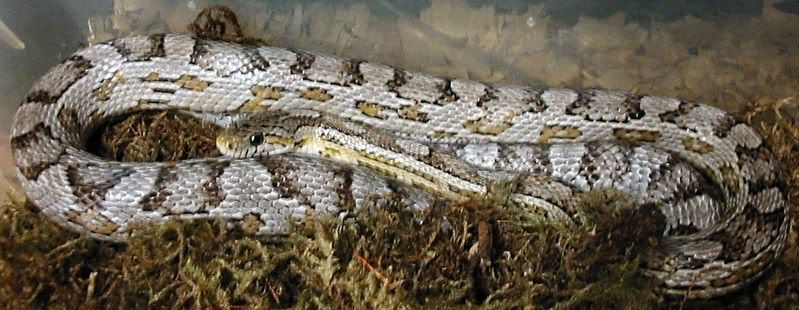
Now that we seem to of discussed the affects of amelanism quite a lot here, what influence would the anery "A" or charcoal gene have as an effect on the selective production of the miami phase. I am fond of the anery morph, but cant help but think that like the candy cane, there must be a method of purifying its dark qualities to selectively breed a corn snake that has a light grey ground colour and black saddles(this is my goal).:dancer:
If anyone has any knowlege of this i wuold be interested to learn. Also i live in the UK and if anyone knows of any breeders that are producing dark anerys i wuold be interested to know?
 
there must be a method of purifying its dark qualities to selectively breed a corn snake that has a light grey ground colour and black saddles(this is my goal)

Like this?
aprilcorns005.jpg
 
The miami phase you're used to is a highly line-bred animal. It does not look overly much like the original locality by now, I'd think. Just as Abbott's Okeetees do NOT look particularly like the pure locality anymore. Thus, an albino version of such a locality probably would look simply like a lighter than usual, but otherwise fairly normal amel.
Then stop thinking.:fullauto: Start re-searching. :bang::bang:
 
So you're telling me that if I go down to miami, I will find animals just like what LBR is producing? SWEET!

Carol's animals look they could be used to create awesome candycanes... eventually... and when I think Miami phase, without locality attached, her animals are what I think of. And while they are clearly related, her animals are still quite different now from the original locality's look. The background and colors are much cleaner and brighter. Just as you can still tell that an Abbott's is an okeetee, but it is in its own way pretty distinct from the non-line bred locality.

And going from here: http://www.cornsnakes.com/forums/showthread.php?t=37493

to here:

http://www.cornsnakes.com/forums/showthread.php?t=77129&highlight=miami

takes quite a bit of time and effort, which is exactly what was being said about the Candycanes.

Because if you look even on Carol's stunning baby, there's still color on the *skin*. And especially on the localities they have a great deal of speckled orange all over the scales and skin. Thus, without extensive linebreeding, they won't look a thing like candycanes.

My point stands just as strong. You can't just throw amelanism at a pale snake and expect *poof!* a candycane to arise. It's like the morons and their puggles. They created a mix, then bred two mixes together... Oh! It's now a "purebred!". Because you are also forgetting that you have to throw amelanism in there too... and the genes underneath that amel are going to have influence upon the miami-locality look and can do really odd things. The only other choice is to use a candycane, which defeats the purpose of making them from scratch.
 
^ Use of "moron" in the puggle sentence is not meant to reflect upon you at all. I work at a vet hospital, I have to deal with some of the really silly owners of those far too expensive "purebred" mutts, and thus the I'm rather soured on the mix in general. Only realised now that it might be misconstrued.:awcrap:
 
^ Use of "moron" in the puggle sentence is not meant to reflect upon you at all. ....
Like it would be the first time some one on this board thought of me as a moron!!:roflmao::roflmao: Seriously, I apologize to you as well, as my reply was probably far more argumentitive then I meant it to be.


But, actually I am only referring to the albino coloration, and the Miami phase corns influence. Or this sentence.

^...Thus, an albino version of such a locality probably would look simply like a lighter than usual, but otherwise fairly normal amel.

There are several "strains" of "albino Miami" that are now being marketed. Each one looks remarkably similar to a "candycane". Most breeders, when they want to clean up a background color will breed in a miami phase. Carol Huddelson has bred Albino cinder corns, part of the mix of these is?....Miami corns. What do they look like? ....See where I am going here?

Of course there would certainly be variation, some being more orange then others, but if you had an albino "Miami Phase" next to an Albino "Okeetee phase" , I don't think that you would have any trouble differentiating the two.

If you were to take 2 pair of unrelated Miami phase corns and bred the line until you got spontaneous albino's, I think you would be surprised at the way they looked.
 
What I'm wondering here is the thing I've heard concerning candycanes: instead of lacking the orange shades of the background, the white tends to COVER it.

I'd want to create a "normal cane", meaning a normal brown saddled corn with as white background colour as possible. I've discussed about the project with a few corn breedes and received very different opinions. Now I don't know what to think...

1) As candycanes lack all melanin (black pigmentation) I have no idea how much black/grey tones would a certain candycane pass on to it's offspring. I'm worried that combining Miami phase & Candycane might produce "miamish" normals with very dark grey background. That's exactly the opposite I'm pursuing.

2) IF it's true that the selectively bred white background colour covers all other background colours - orange in case of candycanes - I have no idea how much a certain candycane actually has orange AND black colours in his/her background. I'd only be able to tell that CLEAN CC's have solid white covering it all up, and poor CC's don't have solid white which lets other colours show through. In this case I'm worried Miami & Candy mix might produce just oddly coloured normals with just as much black as tan colouring on the background.

BUT if the part 2 is true and the white indeed covers other colours, then by using candycanes with miami phase in several generations I should be able to produce a "normal cane".


On the other hand one corn breeder told me that I should most definitely not use candycanes based on the two facts I just described. He adviced me to use as pale miamis and crimsons as I can find, then I would get TRULY a normal/miami with as pale background as possible - not a color variation where one colour covers the others.

What do you think?
 
So you want to line breed Miami phase corns to produce brighter Kisatchie's, Emoryis, and / or Rootbeers? Why not just start with one of those?
 
So you want to line breed Miami phase corns to produce brighter Kisatchie's, Emoryis, and / or Rootbeers? Why not just start with one of those?

Did you mean me?

I have no idea what kisatchies, emoryis and/or rootbeers have got to do with breeding a normal corn with white background. Kisatchies are a little controversial, but emoryis and rootbeers aren't literally corns and I'm not planning to mix them with pure corns no matter what the purpose is - and I'd expect the same from all corn breeders.

I've heard that some breeders might have used creamsicles in their candycane lines, and personally I believe that might be the origin of orange candies. But for what I know about finnish candycane lines, those are as close to pure corn as possible. So even if I use dark red candy (most likely to be pure) in my project and produce a normal corn with white background, that doesn't have anything to do with kisatchies, emoryis and rootbeers. Just as well as crimson and silver queen has nothing to do with emoryis or rootbeers.

So I don't really understand your point here... :shrugs:
 
Back
Top