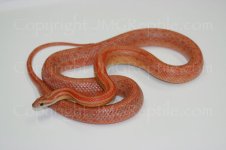
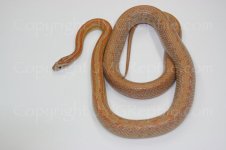
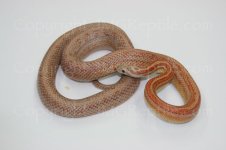
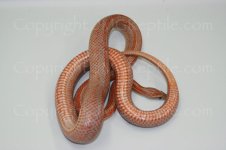
Menhir
Charmelippe
Joejr14 said:The snake in question is obviously nothing more than an upper keys stripe. The stripe gene already has a name
Have you proven this gene to be the same as striped? :shrugs:

Joejr14 said:The snake in question is obviously nothing more than an upper keys stripe. The stripe gene already has a name

Menhir said:Have you proven this gene to be the same as striped? :shrugs:
Joejr14 said:I haven't
How does someone claim a new trade name without actually testing out his snakes? I thought that was a big no no? Why's he getting a free pass?
Menhir said:No twist at all. If the genes are allelic and (with a high probability) the same mutation, then one would get stripes. Since "Key" is not a genetic trait. If Granite is a different gene, you'd get Normals het. granite, striped. The true question would be - are only pure Keys hom for Granite called Granite? :shrugs:


jaxom1957 said:The photos are very helpful, thanks. The females does appear to be very similar to the Keys snakes in question. Do you intend to prove her out with a striped male to test the compatability of her form of striping with the existing stripe pattern gene? Should they prove to be the same gene, I believe the issue of which snakes should be called "granite" would be rendered moot. Mutations that alter pattern alone haven't, from what I've seen, been given any unique trade name of their own. Rather, "Motley", "Stripe", "ZigZag", etc., have been used as modifiers to trade names, ie: "Lavender Stripe" and "Amel Motley" rather than "Poledance" and "Graffiti". Because the color seemed to be linked to the diffusion, bloodred combinations have been given unique names, but I see more and more breeders using "diffused" or "bloodred" as a modifier rather than using a trade name for the combination. I personally find that more informative; I know to expect the color of a charcoal lightened and the patter altered. I also find it more in keeping with the normal tendency to use pattern names by themselves rather than in a blended morph name.

Eremita said:Uh, okay. Dean doesn't often ask for any support (in fact I've never seen this before), and I'm happy to oblige. In all of the discussions I've read, Dean actually has shown plenty of respect for pretty much anyone with experience breeding and keeping corns, even if in some cases he has contrary opinions. In addition, he seriously considers all points raised in such contexts and from my perspective has never been arbitrary or irrational in his conclusions.
Otherwise, I'm a bit exhausted of the topic, though.
-Sean

Drizzt80 said:WE (meaning CS.com) are chastised for "stealing" the Granite name and accused of being self righteous and labeling ourselves the "naming authority" due to our lack of listening to other sources of information . . . BUT, when the issue resurfaces and comes to light and is debated, no other forums (kingsnake or the source) are included in the discussion . . . This can only mean one of two things:
1. This issue is NOT as important as I was led to believe and therefor the naming of Anery Bloodreds as Granites doesn't matter, OR
2. CS.com IS the naming authority, as the discussion hasn't been taken to other forums for discussion, and hence using Granite for Anery Bloodreds doesn't matter.
I'm fine with that . . . I guess. :shrugs:
D80
 and I think that's almost at par... :sidestep:
Exactly!!! That is why I posted what I did in post 100 on this thread. If they are really stripes....then keys stripes seems farily appropriate.Joejr14 said:I guess I'm confused on something here....
So why does this guy get to name his upper keys stripes 'granites'? What's so wrong with calling it exactly what it is? An upper keys stripe.

Until test breedings are done between the Keys granites which appear striped and corn snakes with the motley-related stripe gene, no one is in a position to refute the original breeder's contention that his snakes represent a new morph. The snakes may be nothing more than striped Keys, but they also may be something completely different. If their gene is not compatible with stripe, the breeder certainly had a basis for electing to call his snakes by a unique morph name, and some respect should be shown for his choice.MohrSnakes said:Exactly!!! That is why I posted what I did in post 100 on this thread. If they are really stripes....then keys stripes seems farily appropriate.
We may not be able to refute that the snakes are a new morph, however, I personally think arguing over a name for an unproven morph is a little silly. It appears there needs to be a lot more done with this "morph" before anyone really knows anything. :shrugs:jaxom1957 said:Until test breedings are done between the Keys granites which appear striped and corn snakes with the motley-related stripe gene, no one is in a position to refute the original breeder's contention that his snakes represent a new morph. The snakes may be nothing more than striped Keys, but they also may be something completely different. If their gene is not compatible with stripe, the breeder certainly had a basis for electing to call his snakes by a unique morph name, and some respect should be shown for his choice.
There's no Big Book of Corn Rules, so I don't expect real answers, but I have to question how these informal naming rules work. Do they only apply to new genes, or do they apply to new looks and combos as well? Does it matter if these Keys-Granites express the stripe gene with which we're already familiar? Even if it is the familiar stripe gene, would it make a difference if it spontaneously appeared in Keys lines or if it was introduced from outside of Keys lines? (Good luck proving that anyway.)jaxom1957 said:Until test breedings are done between the Keys granites which appear striped and corn snakes with the motley-related stripe gene, no one is in a position to refute the original breeder's contention that his snakes represent a new morph. The snakes may be nothing more than striped Keys, but they also may be something completely different. If their gene is not compatible with stripe, the breeder certainly had a basis for electing to call his snakes by a unique morph name, and some respect should be shown for his choice.
The approach I took was to review current trade names, noting when new names were created and when descriptors were added to existing names. It become apparent that color morphs and combinations of color morphs were usually given new trade names, but morphs combined with patterns were not. A caramel hypo became an amber, but a caramel motley was still called a caramel. Color morphs combined with bloodred were being given trade names, which, to me, seemed at odds with the common practice. However, bloodred was initially treated as a color morph, and only later was the diffused pattern associated with the morph treated as a pattern morph on its own.Roy Munson said:There's no Big Book of Corn Rules, so I don't expect real answers, but I have to question how these informal naming rules work. Do they only apply to new genes, or do they apply to new looks and combos as well?
I think it matters more whether the two are in fact one mutation than it does whether one was introduced into the other. The compatibility is what I find important.Does it matter if these Keys-Granites express the stripe gene with which we're already familiar? Even if it is the familiar stripe gene, would it make a difference if it spontaneously appeared in Keys lines or if it was introduced from outside of Keys lines? (Good luck proving that anyway.)
You are free to use whatever name you find appropriate, just as Rich Z was free to call his snakes "mocha". However, there is no guarantee that other hobbyists will use the term you choose. If the buying public decides that your snakes are best described as "paisley", you may end up the proud originator of paisley corn snakes rather than matrix corn snakes or kingpin cornsnakes or whatever other name you prefer.What about a situation like the "Matrix" corn I just bought. That name was coined by the Bensons at Ultimatecorns where the snake was produced. They sold the snake as a hatchling, and I bought it as an adult. If I prove that this snake's pattern is the result of a single recessive gene, am I bound by unwritten corn honor to oblige the Bensons' original name for the look, or can I name it what I want?
No one "owns" a name until they trademark it, something that hasn't happened with corn snake morphs yet (to my knowledge). Should respect be shown to both the Bensons and to you by avoiding naming some other morph "matrix"? In my opinion, the answer is an obvious "yes", but that is just one man's opinion. I don't dictate the ethics of other hobbyists.And if I'm not obligated, and I name it something else, is the "Matrix" name up for grabs, or do the Bensons own it forever? Or do I own it forever since I purchased the original animal and changed the name?
I would place myself with those who think a Keys snake expressing the already familiar stripe gene needs no new trade name because I don't believe the addition of a pattern morph to any color morph requires a new trade name. That having been said, neither do I feel that the addition of a gene for diffusion merits anerys being given a new trade name. Even if it merited such, simple respect for the person who already used the name granite for his Keys snakes would cause me pause about using the same name for a completely different morph or combination of morphs. I find it ethically questionable to usurp a previously used name for a morph, however poorly publicized or how little test breeding had been done to prove it out. Granite should no more have been used for anery bloodreds than should have mocha or matrix.Some people seem to be claiming that if the Keys-Granites are proven to be nothing more than Keys-Stripes, that they don't need a special morph name of their own other than Keys-Stripes. If this IS proven, then will that make it ok for us to continue to use "Granite" for Anery-Blood? Are we premature in trying to rename Anery-Blood Granites since, despite their long history, the Keys-Granites are STILL unproven as being anything other than a Keys-Stripe?
There are no legal rights in question, but there are questions of ethics. There was a period of time after hobbyists began to use granite as a trade name for anery bloodreds in which the previous use of the name was brought to their attention. For me, the ethically correct choice would have been to abandon using the term for anything other than that original Keys snake morph, then and from then on. Choosing another designator at that time, when relatively few anery diffused existed, should have been no more difficult than choosing lavender over mocha. That hobbyists who were aware of the prior use continued to use granite saddens me. It reflects poorly on our business ethics and diminishes my opinion of our community as a whole.I'm serious when I say that I have no idea how this naming-rights business works. Unfortunately, no one else knows how it works either since there aren't any consistent or agreed-upon guidelines.
The free marketplace benefits from its gadflies, those who are willing to voice unpopular opinion and point out the clay feet of even its most beloved idols. It's possible that nothing will change, that hobbyists will shrug their shoulders and let the slight stand. The result just might be that, as a community, we decide to be better than that, to accept that a mistake, however innocent, was made and take steps to rectify it. Whether granite remains the popular choice for anery bloodreds is of less importance to me than the lesson I take from the controversy: before I exercise my right to name charcoal lavender ultramel diffused line I created last week "poledancers", I'll do a bit of research first to avoid stepping on the toes of any possible "poledance" predecessors.Right or wrong, the marketplace paradigm (i.e., the "if it sticks" system) is the only one that I can make any sense of at this point.
jaxom1957 said:Until test breedings are done between the Keys granites which appear striped and corn snakes with the motley-related stripe gene, no one is in a position to refute the original breeder's contention that his snakes represent a new morph. The snakes may be nothing more than striped Keys, but they also may be something completely different. If their gene is not compatible with stripe, the breeder certainly had a basis for electing to call his snakes by a unique morph name, and some respect should be shown for his choice.
How can anyone argue against such a cogent, insightful response?Joejr14 said:Bullhonkey.
If the parents are known to carry the genes necessary to create a sunkissed amel charcoal, you are free to call your snake anything you like. The rest of us have the right to either call the combination something else, if we prefer, or to call it nothing at all until we see what offspring it produces. What we don't have the right to do is to name our lava amel charcoal by the same name if we are aware of you prior use. The only snakes that should, ethically, be called by the name you elect for your sunkissed blizzard are other sunkissed blizzards.Imo, you have no business 'creating a trade name' for something that is unproven.
Does that mean I get to run out and create a name for sunkissed blizzard because I'm 99% sure my snake is homo sunkissed, amel and charcoal? Or do I need to wait to test it out?
Since I don't know what you're talking about, I have no response to that question. Joe was able to name a combination "Topaz" based on the appearance of the hatchlings; he did not have to wait for the offspring to grow to adulthood and reproduce themselves. Had he done so and the snakes did not breed true, it would not invalidate the name for the combination, merely the validity of those particular snakes using it.Was nobody able to question Joe Pierce when he first put up his 'translucent' corns on the market?
You seem to have jumped to the conclusion that he hasn't proven his morph. Based upon what? Offspring are being offered that are either homo or het for the trait in question, indicating that he has, in point of fact, proven the morph. Whether or not his snakes carry the same gene widely called stripe has yet to be tested, to my knowledge, but that doesn't invalidate his claim that his Keys snakes differ from other Keys snakes in a manner which is reproduceable and consistent with Mendelian genetics. Should their pattern gene prove to be the same as the known stripe gene, his claim to the morph name granite would be meaningless. However, until that claim is rendered moot, usurping the name granite for an unrelated morph combination is, in my opinion, ethically inexcusable. If you or anyone else is unsatisfied that his snakes represent a new morph, you are free to ignore them. Continuing to call anery diffused snakes "granite" smacks of arrogance and is the classic definition of hubris: to intentionally diminish another's honor. No wonder he doesn't care to debate the issue, when those on the other side have already shown they have no respect for him.Until someone has proven what they have as new, I'm going to question it. And I'm certainly not going to adhere to calling something some bizarre new trade name just because it doesn't look 'normal' when you haven't taken the time to test it out. The originator of the 'granite' corn has made it perfectly clear via his ad on Kingsnake that he wants nothing to do with any discussion about the name, nor does he want to discuss the genetics of the animals in question.
...So, if he's unwilling to spend some time testing his 'granites' out with a stripe corn to see if what he has is in fact a new morph, I'm totally unwilling to call his snakes 'granites'.

I heard it because I was the one who chopped the damn thing down. TIMBERRRRRRRRRRRR !!!!!!! :grin01: :sidestep:Joejr14 said:"If a tree falls in a forest, does anyone hear?"

Joejr14 said:What we have going on here is a guy selling what appears to everyone as an upper keys stripe. All this guy has done is proven the trait to be inheritable, and Mendelian recessive. :shrugs:
tom e said:Is that a fact? I'm not being smart, I just don't know.. How do you know that he has not proved them out as a seperate gene from stripe? That's kind of an odd statement to make unless you know for sure...
I believe I said that on one of my posts.